Music can help your parent connect, express feelings, and find comfort – but it does not reverse dementia. I suggest starting with one familiar song for 5–10 minutes, at a comfortable volume, with no pressure to sing or play.
A 2018 review of 22 studies involving 1,097 people found probable improvements in depressive symptoms and behavior, but little clear effect on cognition or agitation.
My approach is simple:
- Follow today’s response. Offer listening, humming, or a safe, lightweight instrument.
- Stop for discomfort or refusal. Quiet listening counts; participation is not a test.
- Keep brief notes and share the care. Track preferences and reactions so other caregivers can follow the same routine.
<u>Home music activities are not clinical music therapy.</u> A board-certified music therapist can set treatment goals. Seek medical assessment for sudden changes in behavior or alertness rather than relying on music.
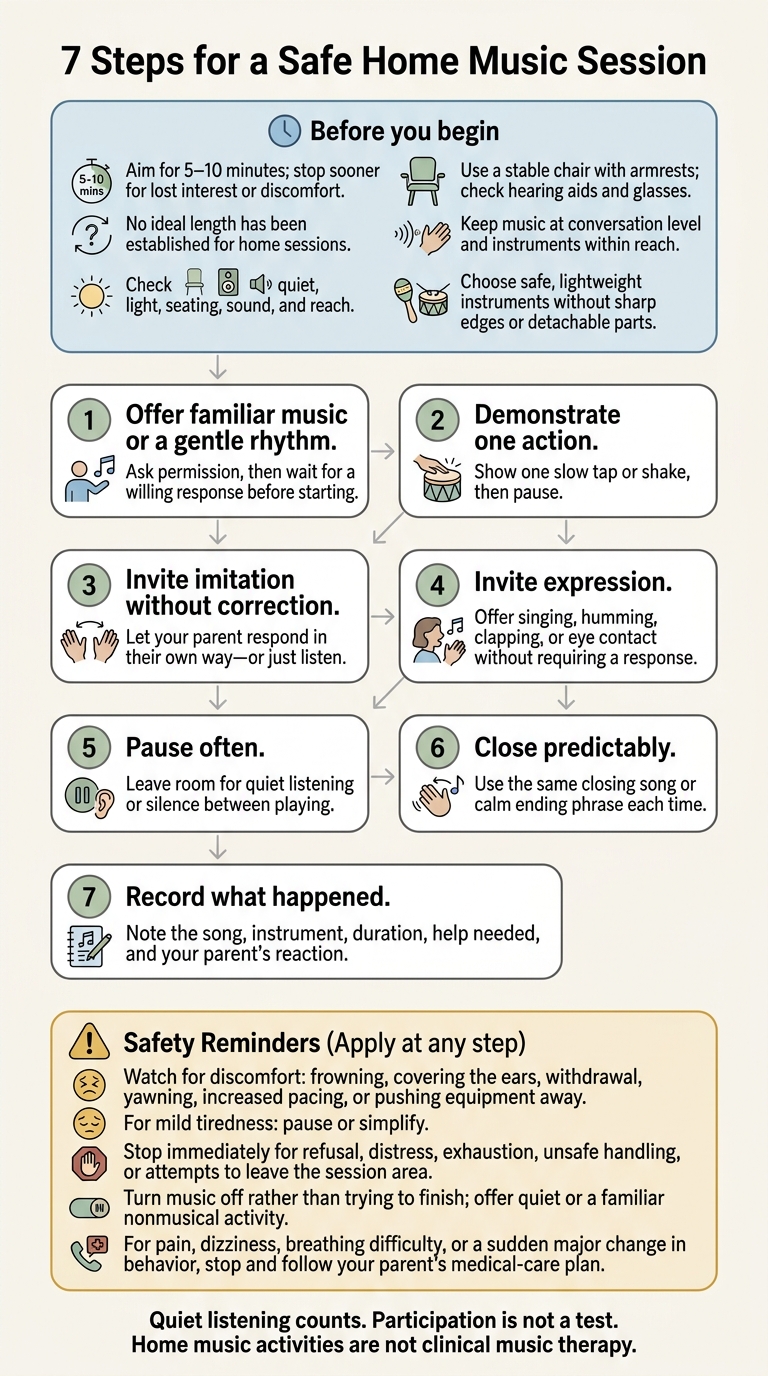
7 Steps for a Safe Home Music Session
How to use music in dementia care
sbb-itb-48c2a85
1. Choose Music Your Parent Enjoys
Build a short music history to find songs your parent still enjoys today. Ask about favorite artists, dances, faith traditions, songs linked to family events, and instruments they played. Records, concert programs, family photos, and relatives can offer clues. Then try a few familiar songs that invite tapping, humming, or singing. The Alzheimer’s Association recommends familiar, enjoyable music and letting the person choose when possible.
If speaking is difficult, offer two or three familiar choices, one at a time. Watch for tapping, relaxed posture, singing, or a request to keep going. Quiet listening counts, too. These responses show engagement in the moment.
A once-loved song may now cause tension or agitation, so let today’s response guide you – not past preferences. Ask permission before starting, and respect refusal as meaningful communication.
Compare Music Activities
Once you know which songs your parent welcomes, choose an activity that fits their current abilities. Consider hearing, vision, hand strength, coordination, mobility, energy, and interest so they can take part safely. The purposes below are goals, not promised results.
| Activity | Best suited for | Intended purpose | Supervision | Cautions |
|---|---|---|---|---|
| Familiar-music listening | Someone who can hear and tolerate sound | Comfort and connection | Check volume and response | Avoid sudden, loud, or unwanted music |
| Singing or humming | Vocal or nonverbal participation | Expression and shared attention | Offer gentle prompts | Do not pressure lyric recall |
| Simple percussion | Safe grasping or tapping, with adjustments as needed | Rhythmic engagement | Stay close throughout | Avoid heavy, sharp-edged, or loud instruments |
| Familiar-instrument playing | Prior experience helps, but trying simple sounds also works | Enjoyment and self-expression | Simplify and assist as needed | Do not require accuracy |
| Call-and-response or gentle seated movement | Brief attention and following a simple cue | Turn-taking and movement | Give one-step cues; observe closely | Stop for pain, dizziness, fatigue, or distress |
Pair Simple Instruments With Familiar Songs
Offer one lightweight shaker or soft hand drum with a song your parent welcomes. Briefly show how to use it, then invite them to join without correcting the beat.
Choose an instrument without loose parts or sharp edges. For weak hands, try a larger handle or a padded tapping surface. If your parent has played music before, they may prefer a familiar instrument. Keep it simple with a short piece of melody, one repeated chord, or free playing.
Holding the instrument, tapping once, or taking a turn all count as participation. If playing becomes frustrating, switch to humming or listening. Start with just one simple instrument and one familiar song.
2. Plan and Lead a Safe Music Session
Once you’ve chosen music and a simple instrument, plan a short, predictable first session. Aim for 5–10 minutes, but stop sooner if your parent loses interest or seems uncomfortable. No ideal length has been established for home sessions.
Prepare the Room and Instruments
Remove distractions and clear enough space to move around easily. Before each session, check quiet, light, seating, sound, and reach. Provide a stable chair with armrests, check hearing aids and glasses, and sit where your parent can see your face and hands. Keep music at conversation level. Place instruments within reach so there’s no need to bend or stretch.
Check the shaker, hand drum, or simple keyboard before use. For limited grip, choose large handles or broad tapping surfaces. Avoid heavy equipment, sharp edges, detachable parts, dangling strings, and complex controls. If your parent mouths objects, keep small items out of the session and supervise continuously.
Use headphones only if your parent tolerates them. Keep the volume low, and stop if they seem anxious or try to remove them.
Lead the Session in 7 Steps
These steps support attention, communication, expression, and social interaction.
- Offer familiar music or a gentle rhythm. Ask permission, then wait for a willing response before starting.
- Demonstrate one action. Show one slow tap or shake, then pause.
- Invite imitation without correction. Let your parent respond in their own way – or just listen.
- Invite expression. Offer singing, humming, clapping, or eye contact without requiring a response.
- Pause often. Leave room for quiet listening or silence between playing.
- Close predictably. Use the same closing song or calm ending phrase each time.
- Record what happened. Note the song, instrument, duration, help needed, and your parent’s reaction.
Match the activity to your parent’s current ability, and use your notes to track what works.
Watch for Discomfort and Know When to Stop
Watch for frowning, covering the ears, withdrawal, yawning, increased pacing, or pushing equipment away. If your parent seems mildly tired, pause or simplify the activity.
Stop immediately for refusal, distress, exhaustion, unsafe handling, or attempts to leave the session area. Music can bring up grief or unwanted memories. Turn it off rather than trying to finish, and offer quiet or a familiar nonmusical activity.
For pain, dizziness, breathing difficulty, or a sudden major change in behavior, stop and follow your parent’s medical-care plan.
3. Adjust Activities and Track Responses
Match Activities to Dementia Stage and Ability
Let earlier sessions guide what you try next. Match the activity to your parent’s hearing, attention, movement, and energy today – not their dementia stage label. Treat these options as starting points, not tests.
| Dementia stage | Music choices | What to try |
|---|---|---|
| Mild | Favorite songs; optional familiar lyric sheets | Offer two song choices, a familiar instrument, or a simple repeating rhythm. |
| Moderate | Short, repetitive songs | Offer familiar percussion, one instrument at a time, with one-step directions. |
| Advanced | Familiar music chosen for comfort | Invite listening, humming, or gentle tapping without requiring participation. |
Skip lyric tests, and shorten the activity when attention fades. Put away lyric sheets or switch from playing to listening as needed. Ask permission before offering physical guidance. Continue only while your parent is comfortable, and stop physical guidance at the first sign of tension.
Keep a Simple Session Log
Record the date, time, songs, instrument, and time actively engaged – not just total session length. Note your parent’s mood before and after, words spoken, nonverbal responses, any distress or agitation, and willingness to participate again. Add context such as poor sleep, pain, or medication changes. Record what you observe rather than labeling the session a success or failure.
Look for patterns across several sessions. One pleasant session does not prove lasting benefit or better daily functioning. Use the log to change one variable in the next session, then watch how your parent responds.
When to Seek Professional Guidance
If the log shows repeated distress or no clear pattern, share it with a clinician. For severe symptoms, hearing or movement problems, or an individualized treatment plan, consult your parent’s clinician or a board-certified music therapist (MT-BC). You can search for an MT-BC through the Certification Board for Music Therapists.
Seek prompt medical assessment for sudden or unexplained changes in behavior, alertness, or functioning. Illness, pain, medication effects, or delirium may be involved. Music should not delay assessment, and responses will differ from person to person.
Conclusion: Make Music Part of the Care Plan
Make music part of your parent’s routine – not a performance goal. Choose familiar songs and simple, safe instruments. Let their response guide whether to continue.
As you try different songs, instruments, and session lengths, keep the approach simple. Include music in the care plan alongside medical follow-up, daily routines, and safety support.
Share Music Preferences and Caregiving Tasks
Share the routine so it’s easier to keep up. Create a shared music profile that includes preferred songs, volume limits, disliked sounds, and distress signals.
Split tasks such as updating the playlist, checking and cleaning instruments, and leading activities. Review the plan together so one caregiver doesn’t carry the whole load.
ElderHonor offers its Toolkit, courses, and coaching as educational resources – not clinical therapy. These resources support family conversations, aging-in-place planning, and sharing caregiving tasks.
FAQs
How often should I offer music activities?
Make music part of your loved one’s daily routine, not just special events. Play personalized playlists during meals, caregiving tasks, transitions, and before bedtime.
During visits, keep songs at a soft volume to help you connect and offer comfort. Use gentle music consistently throughout the day, choosing songs that match their emotional needs.
Can music help my parent during daily care?
Yes. Music memory often lasts even in advanced dementia, so music may help regulate emotions, reduce agitation, and make daily transitions easier.
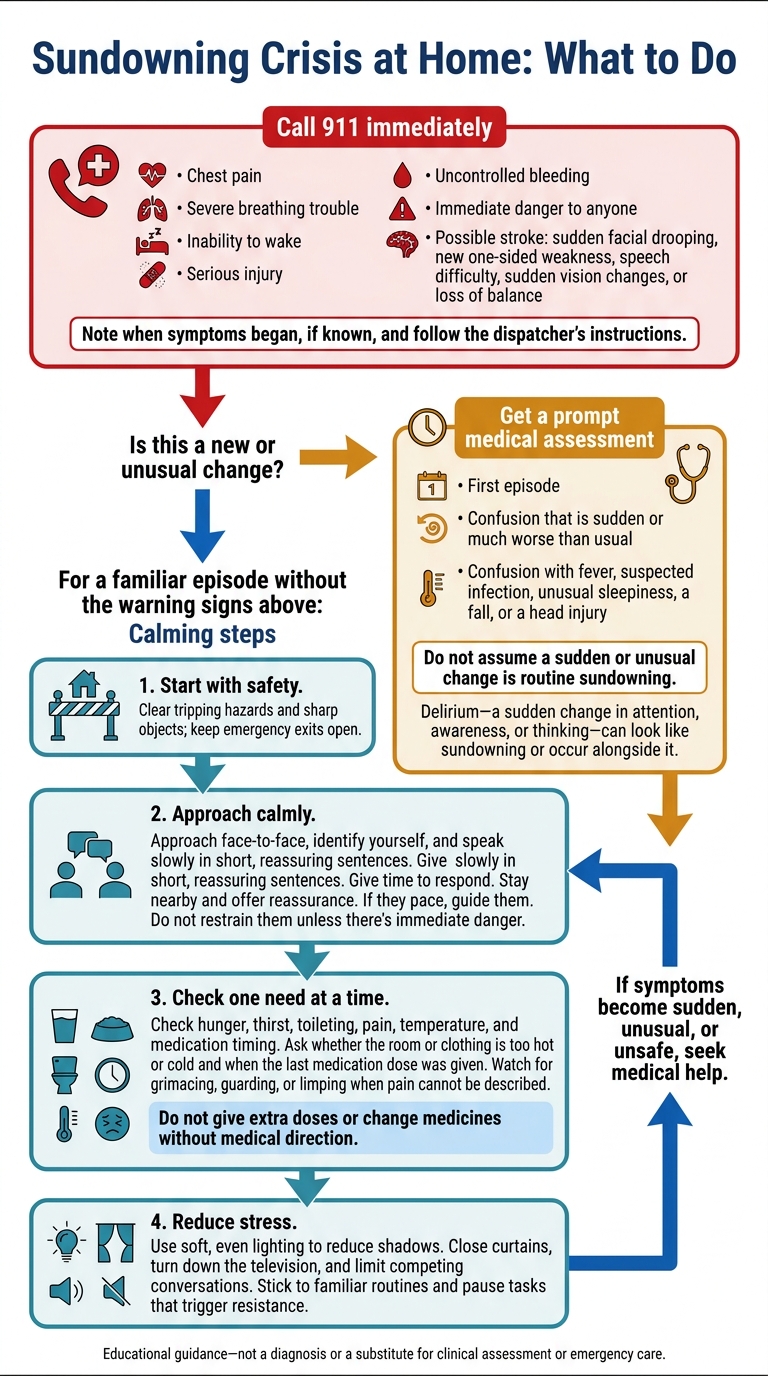
Build playlists with songs from your parent’s young adult years. Try soft instrumental music during bathing or dressing, and calming melodies in the late afternoon to help manage sundowning. Singing, humming, or tapping along to a rhythm together can help you connect emotionally when words become difficult.
How do I choose a qualified music therapist?
Look for professionals who specialize in dementia care. Your local Area Agency on Aging (AAA) is a good place to start for referrals to community programs and resources. If your parent lives in a memory care facility, ask the staff about their experience with music-based interventions and which specialists they work with.
ElderHonor offers educational resources and tools to help you work through these care decisions.