
Yes, an advance directive from another state may still work – but only if the state where care happens accepts it. In most cases, hospitals look first at where the patient is being treated, not just where the form was signed.
Here’s the short version:
- There is no single U.S. form for advance directives.
- Most states accept out-of-state documents in some situations, but not every form gets the same treatment.
- Health care proxy or medical power of attorney forms usually travel best.
- POLST forms often do not travel well and may need a new in-state form.
- Hospitals check the details first: names, dates, signatures, witnesses, notarization, and whether a newer form exists.
- Travel and moving are different:
- For travel, keep copies easy to reach.
- For a move, fill out the new state’s forms.
- Old, blurry, missing, or conflicting documents can delay care.
About 50 states and D.C. each use their own rules, so even when a hospital accepts an out-of-state directive, it may still apply local law to treatment choices. That is why recognition does not always mean identical enforcement.
If I were helping a parent travel or move, I’d focus on one goal: make sure one current version is signed, shared, and easy to find.
| Document | Main Job | How well it travels |
|---|---|---|
| Advance directive | General term for care wishes and, at times, agent naming | Depends on what is included |
| Living will | States treatment wishes | May run into wording-rule issues |
| Health care proxy / medical power of attorney | Names who can decide | Often the easiest to use across states |
| POLST / MOLST / MOST | Medical order for current treatment | Often needs a new state form |
This article explains what usually counts, what slows things down, and what I’d do before travel or after a move.
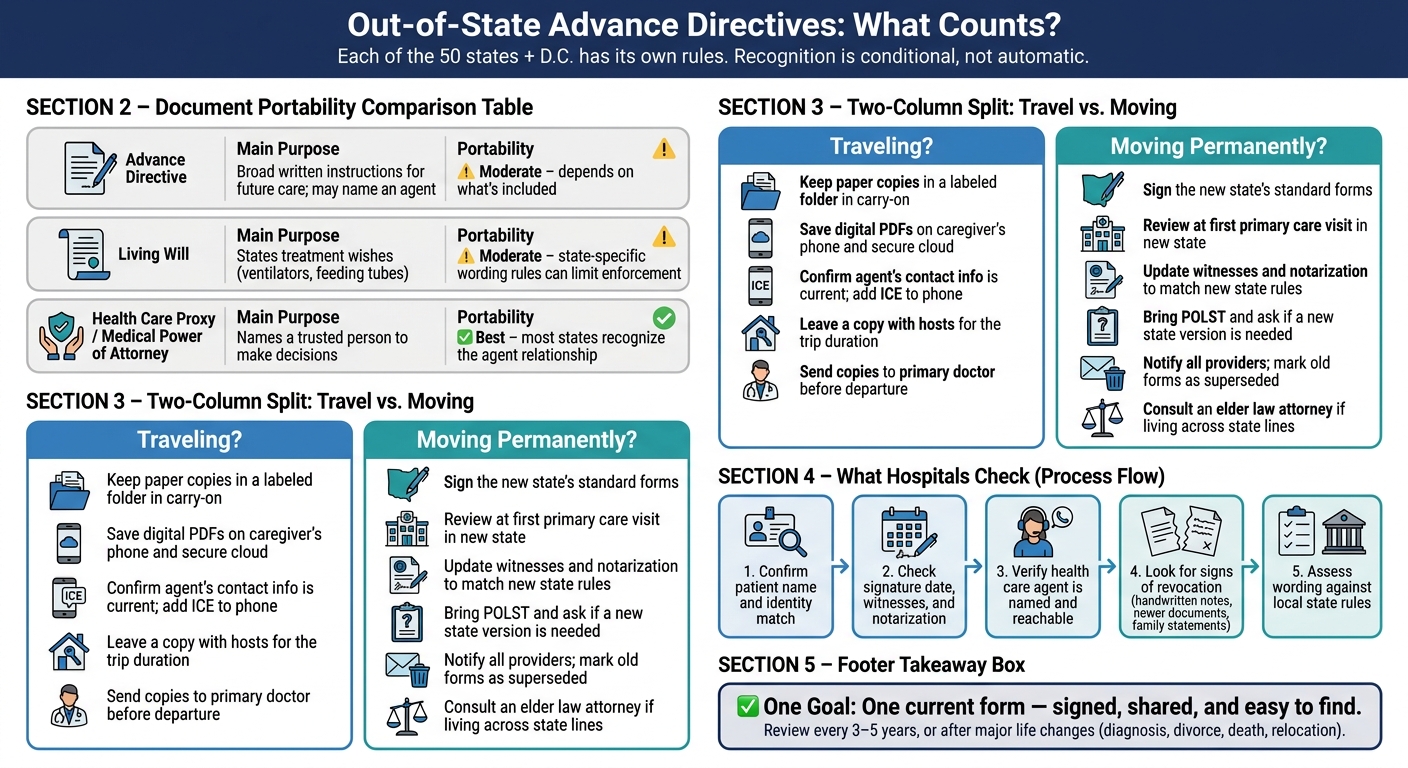
Advance Directive Portability Across State Lines: A Quick Guide
When Another State Will Accept an Out-of-State Advance Directive
Most states do have rules that explicitly validate out-of-state advance directives, but not all of them do. Most states explicitly recognize out-of-state directives. Still, recognition is conditional, not automatic.
In plain English, a document may be honored for one of two reasons: it was valid under the law of the state where it was signed, or it also happens to meet the rules of the state where it’s being used. That’s why documents that satisfy more than one state’s formalities tend to travel better.
But acceptance is not the same as identical treatment. A state might accept an out-of-state directive on its face, yet still apply its own law when it comes to the details. So the document may be honored in principle, while certain instructions are limited if they clash with local rules. One common example is a state’s rule on withdrawing artificial nutrition and hydration unless the document says so in very specific language.
Advance Directive, Living Will, Health Care Proxy, and POLST: What Each One Is
The type of document matters. Not all of these forms move across state lines the same way.
| Document | What It Does | Portability Across States |
|---|---|---|
| Advance Directive | Broad term covering written instructions for future care; often includes both treatment wishes and a named decision-maker (agent) | Generally recognized; portability depends on the specific documents included |
| Living Will | Spells out preferences for life-sustaining treatments (ventilators, feeding tubes) in specific situations | Moderately portable; state-specific language rules can limit enforcement |
| Health Care Proxy / Medical Power of Attorney | Names a trusted person (agent) to make medical decisions if you lose capacity | Most portable; most states recognize the agency relationship across state lines |
| POLST / MOLST / MOST | A clinician-signed medical order for people with serious illness; applies immediately, not just if capacity is lost | Least portable; typically must be reissued on the receiving state’s official form |
A health care proxy or medical power of attorney usually travels best because it does one simple thing: it names the person who can speak for you. Every state has some version of that idea. POLST forms are different. Since they are medical orders tied to state-specific forms and systems, they often need to be reissued on the receiving state’s form.
Federal Law Does Not Create One National Form
The Patient Self-Determination Act (PSDA) requires hospitals, nursing homes, and other Medicare– and Medicaid-participating facilities to ask patients at admission whether they have an advance directive, record the answer, and give written information about patient rights. That’s where federal law stops.
The PSDA does not create one national form. It does not set one set of witness or notarization rules. And it does not tell states how to handle out-of-state documents. Instead, it leaves those issues to state law.
So if a patient from Arizona is admitted to a hospital in Ohio, the hospital must ask whether that patient has an advance directive and note the Arizona form in the medical record. But Ohio law still decides whether the form is fully binding and how its instructions will be carried out.
That state-by-state approach affects the details that matter most:
- who can act as a witness
- whether notarization is required
- what wording must appear in the document
- who may legally serve as an agent
Those rules vary from state to state. That’s why a form that is valid in one place can still get extra scrutiny somewhere else. In practice, that’s often the first thing a hospital checks before relying on the document.
sbb-itb-48c2a85
How Hospitals and Care Teams Review Out-of-State Documents
When a patient is admitted, staff usually ask if the person has an advance directive and request a copy for the medical chart. If that directive was signed in another state, the care team doesn’t just glance at it and move on. They verify it before using it to guide care. And if no copy is available, things can slow down fast. In that case, staff may have to piece together the patient’s wishes from what family members remember, which can delay treatment.
What Staff Check Before Relying on the Document
Once the document is in the chart, staff first make sure it belongs to the right patient. They check the patient’s name and other identifying details. They also review the signature date and confirm the directive was signed, witnessed, or notarized in the way the form required.
If the directive is older, staff may take a closer look to see whether it still matches the patient’s wishes. They also check whether a health care agent is listed and whether that person can be reached without much delay if a decision has to be made.
The team also watches for clues that the directive was revoked or replaced. That can include:
- handwritten notes saying the document is void
- a later document in the chart that says something different
- a family statement that a newer version exists
What Commonly Causes Delays or Disputes
Some problems are pretty basic, but they still create major hold-ups. Missing pages, especially the signature page or the page naming the health care agent, can make it hard to confirm that the document is valid or to tell who has authority to speak for the patient. Blurry scans and faxed copies cause the same kind of trouble. If signatures, dates, or notary seals can’t be read, staff may not be able to verify the document.
Differences in wording can also slow things down. If the form doesn’t line up with local rules, the care team may need to clarify what the patient wanted or turn the directive into local medical orders. Out-of-state POLST forms often serve as proof of the patient’s wishes, but hospitals usually enter local orders on the receiving state’s form.
Disputes can get more complicated when family members don’t agree about what the patient wanted, or when the chart includes forms from more than one state. In those cases, hospitals may bring in an ethics committee or legal counsel to sort out which document controls and how it should be read.
What Families Should Do When Traveling or Moving to a New State
Travel and relocation are not the same thing. A short trip is mostly about fast access. A permanent move is about making sure the paperwork fits the new state’s rules.
Because staff often check these documents before using them, families need to plan for both day-to-day access and state compliance.
Traveling: Keep Copies Ready and the Agent Easy to Reach
When you’re traveling, speed matters most. Bring the directive, health care proxy, POLST or DNR, medication list, diagnoses, allergies, and contact cards for the agent, backup agent, and doctors.
Keep paper copies in a clearly labeled folder inside the parent’s carry-on bag. Save digital copies in a secure cloud folder and on the caregiver’s smartphone as clearly named PDFs. If the parent will be staying with family or friends, leave a copy with them for the length of the trip.
Before leaving, double-check that the agent’s contact details are up to date and that they know they may get a call at any hour. Add the agent under ICE in the parent’s phone. It also helps to set a simple rule ahead of time: how many missed calls or texts should trigger a call to the backup agent? Share the trip itinerary too, so the agent can act fast if needed.
If you can, send copies to the parent’s usual doctor before travel and ask for them to be scanned into the medical record.
A trip usually calls for quick access. A move is different. That means going back through the forms under the new state’s rules.
Moving: Review the Document Under the New State’s Rules
Temporary travel and permanent relocation call for different levels of review. A permanent move should trigger a fresh look at the paperwork. The old document may still be accepted, but state rules do change.
After relocation, sign the new state’s standard forms. Hospitals and nursing homes are most familiar with their own forms, which can cut down on delays. Keep the same instructions if they still reflect the parent’s wishes, but update the form so it matches the new state’s signing rules.
At the first primary care visit in the new state, bring the current documents and ask the clinician to walk through local requirements. If new forms are needed, fill them out with the right witnesses and any needed notarization. Then send updated copies to the health care agent, backup agent, close family members, and any care facility involved. Ask providers in the previous state to mark old forms as superseded so there’s less mix-up later if records are pulled.
Bring any POLST to that first appointment and ask whether the new state needs its own version.
If the parent lives across state lines, it’s smart to ask an elder law attorney whether one form can cover both states or if separate forms are the safer choice.
How to Update an Advance Directive and What to Remember
Steps to Update and Share the Current Document
After travel or a move, the next step is to make sure the directive is current and easy to find. Start by comparing the document with the parent’s current wishes. Health can change. Family relationships can shift. Treatment preferences can change too.
A good rule is to revisit the directive after about 10 years, or sooner after a death, divorce, new diagnosis, or decline in health. If none of those happen, review it every 3 to 5 years. These check-ins can also catch state rule changes, agent availability issues, and shifts in treatment wishes before the document is needed in another state.
If the document needs changes, sign a new version that follows the current state’s rules for witnesses, notarization, and forms. The new document should also say clearly that it revokes all prior versions.
That part matters more than many families expect. A new form doesn’t do much good if the old one is still floating around. Revoke earlier versions, collect old copies and mark them as revoked when possible, and notify every provider or facility that has the old form.
Once the updated document is signed, share printed copies with:
- The health care agent
- Backup agents
- The primary care physician
- Key specialists
- Any current facility
Ask providers to place the document in the chart.
The practical goal is simple: one current form, shared with the people who may need it fast.
Key Points to Keep in Mind
Moving to a new state usually means filling out new state forms. Travel is a little different. In that case, the big thing is easy access to copies and current contact information. An old out-of-state directive can slow down decisions when time matters most.
FAQs
Will my advance directive be valid in another state?
Generally, advance directives can be honored across state lines, but that doesn’t mean every state handles them the same way. Acceptance can change based on both the state and the type of document involved, including living wills, health care proxies, DNR orders, and POLST/MOLST forms.
If you travel or move, keep signed original copies on hand and make sure they show the creation and update dates. Include your health care proxy or HCPOA documents too. It’s also smart to review everything now and then so the paperwork is current and lines up with the rules in the state where you’re going.
What if my out-of-state POLST is not accepted?
If an out-of-state POLST isn’t accepted, there’s a simple reason: these forms differ from state to state, both in what they’re called and in what the law requires. And because a POLST is a physician order, state-specific rules may apply.
Check the rules in the state where care is happening. Then make sure your parent’s care planning documents are up to date and match the requirements of their main state of residence or current location.
Should I sign new forms after moving?
Maybe. If you move to a new state, review your advance directives and powers of attorney to make sure they still meet local rules.
Some states require specific forms for certain care settings or legal authority. Because of that, it’s often smart to update these documents with an attorney so they stay valid and current.