One-on-Family Coaching
When your family needs to do this together — and can’t quite get there alone.
Seven 90-minute video sessions with David Moyer, CSA. Whole family in the room. Same C-A-R-E framework as the toolkit, delivered live, with David facilitating the conversation so the pressure of every decision doesn’t land on one set of shoulders.
No commitment until after the intro call · $197 toolkit credit applies if you’ve purchased it
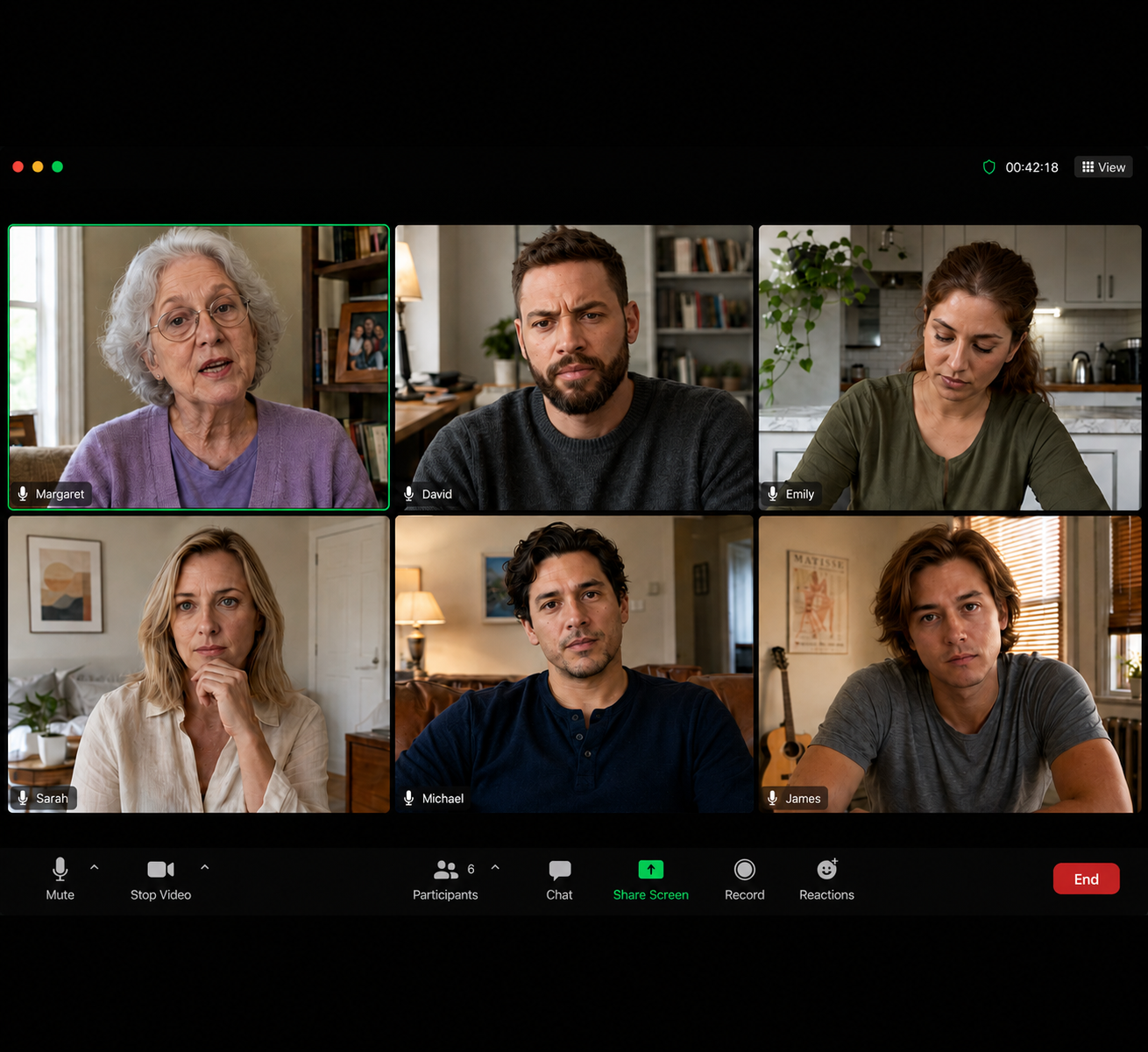
HERO PHOTO
family on a video callor multi-generation family meeting
What this actually is.
Same content as the toolkit, delivered live. Seven sessions, ninety minutes each, on video. Up to six family members in the room together — siblings, partners, the aging parent themselves if they’d like to be part of the conversation. David facilitates. Everyone sees the same content. Everyone hears the same questions. Nobody has to be the heavy.
Between sessions, each family member completes specific homework — assessments, worksheets, decisions to think through. The next session begins by walking through that homework together, comparing notes, surfacing where you agree, working through where you don’t. By the end of the seventh session, you have a written plan your whole family has shaped and signed off on.
This is the path for families whose situation is moving faster than self-paced can keep up with — or for families who’ve tried to talk about this on their own and gotten stuck. The structure does the hard work. You bring the family.
The seven-session arc
Seven structured conversations. One plan at the end.
Each session covers one part of the C-A-R-E framework, with the toolkit content as the spine. Homework between sessions ensures everyone shows up prepared, and the next session opens by working through what each person brought.
Setting the table.
What we’re trying to accomplish, where the family is now, who’s in the room, what each person hopes to get out of this. We meet the C-A-R-E framework and agree on how we’ll work together.
Covers: Module 01 Introduction · setup & alignment
The conversation, started together.
How to talk about aging without it turning into a fight. We work through how each family member sees the situation, where the gaps are, and how care responsibilities should actually divide.
Covers: Modules 02 Starting the Conversation & 04 Division of Care
Honest assessment.
Where things actually stand — health, home, finances, mental wellbeing, the role of distance for siblings who don’t live nearby. We compare what each person sees, then build the shared picture from it.
Covers: Modules 03 Assessing the Situation, 05 Remote Caregiving, 06 Caring for Yourself
Where they’ll live.
Aging in place vs. assisted living vs. memory care. The financial geometry, the medical realities, the trade-offs that don’t announce themselves until you’re inside the decision. We walk through it together.
Covers: Modules 07 Aging In Place & 08 The Move
The last chapter, planned now.
End-of-life preferences, final arrangements, the kinds of grief everyone in the family will experience along the way. The hardest conversation, made workable because nobody has to start it cold.
Covers: Modules 09 End of Life, 10 Final Arrangements, 11 Grief
The practical layer.
Estate, documents, beneficiaries, the items most families never plan for — and end up cleaning up after, often badly. We build the paperwork map and confirm who’s on which document.
Covers: Modules 12 But Wait! There’s More!, 13 Estate Planning, 14 Documents
Build the plan.
We pull six sessions of work into one written document the whole family has shaped and agreed to. Roles assigned. Decisions documented. Timeline set. The plan you’ll actually use when something happens.
Covers: Module 15 Build the Plan · synthesis & sign-off
Why coaching works when self-paced doesn’t
The structure does the hard work, not the family.
Nobody in the family has to be the heavy.
The hardest part of these conversations is that whoever brings them up gets cast as the one with the agenda. With David in the room, the structure raises the questions — not your sister. Tone stays collaborative.
Everyone sees the same content, at the same time.
One of the biggest sources of family conflict is that one sibling has read more, talked to more doctors, and seems to have decided already. Everyone takes the same lesson, hears the same framework, comes to the same questions.
The framework carries the decision-making weight.
Nobody has to invent the questions or hold the gavel. The toolkit defines what we’re deciding; David facilitates the deciding. Family members who normally feel like they’re walking on eggshells can show up and just be honest.
The goal is agreement, not who-shouts-loudest.
The structure of seven sessions plus homework gives every voice room. Quiet siblings get heard. Aging parents stay at the center of decisions about their own life. The plan you walk away with is one the whole family has shaped.
What the homework actually looks like.
Each session ends with a specific assignment for every family member to complete on their own time before the next call. Worksheets, assessments, decisions to think through, conversations to have with one specific person.
The next session begins by reviewing what each person brought back. We work through agreement, surface disagreement, and build the next layer of the plan from what we found. Real work, between real sessions. No one shows up cold.
EXAMPLES OF SESSION HOMEWORK
- Each family member fills out the same Caregiving Self-Assessment and brings it to the next session
- Each person ranks the three biggest concerns they have about Mom’s care, with reasons
- Two specific siblings have a one-on-one conversation about who handles finances vs. medical decisions
- Everyone reviews the same worksheet on home-safety risk and brings their independent assessment
- Each family member writes one sentence about what they’d want if they were in Dad’s position
Is this the right fit?
Who coaching is built for — and who it isn’t.
RIGHT FIT FOR
Coaching is for these families.
- One sibling is carrying it alone, and resentment is starting to build
- Family members disagree about a parent’s care — and conversations keep ending badly
- The situation is moving faster than self-paced learning can keep up with
- You’ve tried having “the conversation” on your own and gotten stuck
- An aging parent is declining and you need to align before the next move
- Toolkit users who realized partway through that they need a facilitator in the room
NOT THE RIGHT FIT FOR
Try something else first.
- Active medical crisis — call 911 or local agencies first, then come back when stable
- Single-person caregiving with no family to align — the toolkit is the right product
- Estate disputes — you need an estate attorney, not a coach
What if the family doesn’t reach consensus?
Most families do. Seven sessions plus the homework arc is enough structure for the vast majority of caregiving decisions to land. But not always.
If a specific decision stays unresolved at the end of the program, your family can book an additional 90-minute mediation session with David, focused on that single question. Not a re-run of the program — a focused tiebreaker session, billed at a post-program rate, scheduled when the family is ready.
The promise isn’t that everyone agrees on everything. The promise is that everyone has been heard, the structure has been honored, and the path forward is one the family chose together — even if the choice was “here’s how we’ll resolve this when we have more information.”
“Families don’t fall apart over decisions. They fall apart over the lack of a way to make decisions.”
Investment
One package. Up to six family members. No surprises.
ONE-ON-FAMILY COACHING
$2,100
- Up to 6 family members in each session
- Same C-A-R-E framework as the toolkit, delivered live
- Homework, worksheets, and assessments included
- Written plan delivered after Session 7
- $197 toolkit credit applies if you’ve purchased it
- LSA-eligible at employer discretion
Start with a free intro call.
30 minutes with David, no commitment. We confirm coaching is the right fit for your specific situation, set expectations, and walk through how scheduling works for your family.
Schedule a free intro call ›If coaching isn’t right for you, we’ll point you to the right resource. No upsell.
A note from the founder
Why I run these sessions personally.
I’ve sat in family meetings about aging parents. Some of them in my own family. The problem is almost never that people don’t care. The problem is almost always that no one has a structure for the conversation — and someone, usually the daughter, usually the one who already does too much, ends up either carrying it alone or playing bad cop.
My wife and I cared for our parents and stepparents for fifteen years. The years that went smoothly were the ones where we had a plan. The rest of them, we spent fighting for every morsel of help and arguing about what should have been figured out years earlier. I learned the hard way that families don’t fall apart over decisions. They fall apart over the lack of a way to make decisions.
I built the toolkit to make the content available to everyone. I run coaching personally because some families need a neutral third party in the room, the same content delivered live, and a structure that takes the decision-pressure off any one of them. Seven sessions, the same C-A-R-E framework, the homework that ensures everyone shows up ready, and a written plan at the end that the whole family has shaped.
If you’ve read this far, your family probably needs this. Schedule a free thirty-minute call with me. We’ll figure out together whether coaching is the right path forward — and if it isn’t, I’ll tell you what is.
— David Moyer, CSA · Founder, ElderHonor
From students of the underlying course
What people are saying.
This course is excellent! It is full of so much information about a subject that isn’t discussed enough. This course helps alleviate that stress with clear teaching and gives you tons of tips and tools to feel confident about making difficult decisions. It is so well organized and easy to go back through and find exactly what you need, when you need it.
Haley D. · Toolkit student
The Caregiver Toolkit course is very comprehensive with many helpful forms, checklists and links. The course focuses on maintaining your loved one’s dignity and honoring them as they age. I only wish this course had been available years ago when my father was still living — some decisions made for their end-of-life care may have been different and more thought out.
Karen F. · Toolkit student
Coaching uses the same C-A-R-E framework and toolkit content as the self-paced course — delivered live with David facilitating, your whole family in the room.
Common questions before you commit.
Start with a thirty-minute conversation. No commitment.
Tell us where your family is, what’s in front of you, and what’s at stake. We’ll figure out together whether coaching is the right path forward — and if it isn’t, we’ll point you to what is.
Free 30-min intro call · no payment until after the call · no upsell pressure
HONOR · KNOWLEDGE · LIFE