
Loneliness in older adults can harm health, not just mood. In the U.S., about 1 in 4 adults age 65+ are socially isolated, and poor social connection has been linked to a higher risk of depression, memory problems, heart disease, hospital visits, and early death.
If I had to sum this up in one line, it would be this: companion care helps by putting steady human contact back into a senior’s week. It is nonmedical in-home help built around conversation, shared activities, rides, errands, meal help, and routine.
Here’s the short version:
- Loneliness, social isolation, and living alone are not the same
- Companion care is for social contact and light day-to-day help
- It does not cover bathing, dressing, wound care, or nursing tasks
- Regular visits can reduce time alone and add structure to the week
- It fits best for older adults who are mostly independent but pulling back from daily life
- If hands-on or medical help is needed, other home care services may need to be added
A quick way I look at it: if a parent is safe at home but seems more withdrawn, less active, or alone for long stretches, companion care may be the right next step.
| Support type | Main job | Best fit for |
|---|---|---|
| Companion care | Social contact and light help | Seniors who are lonely or isolated |
| Personal care | Hands-on help with daily tasks | Seniors who need help bathing, dressing, or moving |
| Home health | Medical care at home | Seniors recovering from illness or dealing with medical needs |
Bottom line: companion care does not treat loneliness with medicine. It helps by making sure someone shows up, spends time, and keeps a senior connected to daily life.
Senior loneliness as a health risk
What loneliness, social isolation, and living alone actually mean
These three terms often get lumped together, but they are not the same.
Loneliness is a personal feeling. It means someone feels disconnected or feels that close, meaningful relationships are missing, even when other people are nearby. Social isolation is different. It describes a person with very little social contact or community involvement. Living alone is just a housing setup. A person can live alone and feel fine, or live with others and still feel deeply lonely.
That difference matters. Families often look at a parent’s living setup and assume they’re okay. But loneliness can be easy to miss when you only look at whether someone lives by themselves.
| Concept | What it means | Why it matters |
|---|---|---|
| Loneliness | Feeling disconnected or lacking meaningful relationships | Can harm health even when someone isn’t physically alone |
| Social isolation | Having limited social contact or few relationships | Often less visible to families; increases health risk |
| Living alone | A household arrangement | Doesn’t automatically mean the person feels lonely |
How loneliness affects mental and physical health
Chronic loneliness is not just a sad feeling. It can affect both mental and physical health in serious ways.
The CDC links loneliness and social isolation to depression, anxiety, cognitive decline, dementia, heart disease, stroke, diabetes, weaker immune function, and earlier death.
The U.S. Surgeon General’s advisory found that lacking social connection can increase the risk of premature death as much as smoking up to 15 cigarettes a day. That comparison hits hard, and for good reason. It shows that social connection is not a nice extra. It is tied to health in a major way.
The National Institute on Aging also notes that lonely or socially isolated older adults are more likely to have longer hospital stays, be readmitted more often, and have more ER visits or nursing home placement.
Once loneliness starts affecting health, support at home is no longer just about convenience. It becomes part of the care plan.
Why adult children often miss the warning signs
Most families pay attention to what they can see right away: groceries, medications, doctor visits, and fall risks. Those things matter, of course. But they do not always show whether a parent feels connected to other people.
That is often where loneliness hides.
Many older adults will not come out and say, “I’m lonely.” Pride can get in the way. So can habits shaped over a lifetime, or a fear of feeling like a burden. A son or daughter may visit a few times each week and think that is enough, while missing the long stretches of time in between.
Some signs can point to a deeper issue. A parent may stop going to activities they once liked, make fewer phone calls, or seem down for a long time after a loss or illness. You might also notice messier rooms, stacks of unopened mail, or hygiene slipping.
That is where companion care fits.
sbb-itb-48c2a85
Our seniors are lonely – companion care can help | Andrew Parker | TEDxMiami

What companion care is and how it works at home
Companion care is a nonmedical, in-home service built around steady human contact, not treatment or hands-on physical help. It tends to work best for parents who are still mostly independent but are spending too much time alone, stepping back from things they used to enjoy, or losing the day-to-day rhythm that helps life feel normal. That’s why the details of companion care matter.
What companion care includes
Companion care usually involves light, everyday support. A companion might share a meal, play cards, take a short walk, help with a hobby, or simply sit and talk. They may also drive to appointments, help with errands, assist with simple meal prep, do light housekeeping, and give gentle medication reminders.
The specific task matters less than the steady contact behind it. Those simple visits are often what make the service work.
What companion care does not include
Companion care does not include bathing, dressing, toileting, transfers, wound care, injections, or nursing tasks. Those needs are usually handled through personal care or skilled nursing services.
If a parent needs hands-on help or medical oversight, companion care by itself is not enough.
| Care Type | What It Covers | What It Does Not Cover |
|---|---|---|
| Companion Care | Conversation, meals, errands, light housekeeping, transportation, medication reminders | Bathing, toileting, wound care, nursing tasks |
| Personal Care | Bathing, dressing, toileting, transfers, mobility help | Clinical or nursing tasks |
| Skilled Nursing | Wound care, injections, medication administration, medical assessments, therapy coordination | Housekeeping, companionship, errands |
How families use companion care for aging in place
Most families use companion visits to cover the long gaps in a parent’s week – the hours between family check-ins when an older adult is simply alone. Even a few visits each week can cover the longest stretches alone and give the week a steady social rhythm.
Paired with home safety changes and a solid transportation plan, companion care can help make aging in place easier to keep up over time. The main point is the routine it creates.
How companion care reduces loneliness
Companion care helps cut loneliness because it brings steady human contact back into everyday life. And that matters more than many families expect.
Regular visits reduce isolation and add routine
One of the biggest ways companion care helps is simple: someone shows up on a regular schedule.
If a parent knows a visitor is coming every Monday, Wednesday, and Friday afternoon, the week no longer feels like one long blur of empty hours. Those visits break up time alone and give the day a shape. That kind of rhythm can be calming. It also gives a person something to look forward to.
Research supports this. In one companion care program, 60% of older adults who were severely lonely moved to a lower loneliness category, and they also had fewer mentally unhealthy days each month. That’s a big change. It shows what steady, reliable social contact can do when it happens over time.
Conversation and shared activities restore connection
Loneliness isn’t just about being alone. It’s also about feeling ignored or forgotten.
A companion who listens, asks about a parent’s life, and remembers what they said last week can make a big difference. That kind of attention does more than fill time. It reminds the person that they still matter.
Shared activities can help even more. Things like:
- playing cards
- doing a puzzle
- cooking a favorite recipe
- looking through old photos
These moments can reconnect an older adult with their interests, memories, and sense of self. Studies show that shared activities can improve self-esteem and a sense of belonging in older adults, while also lowering depressive symptoms. The point isn’t the puzzle or the recipe. It’s the shared focus and the feeling of doing something with someone.
Light support removes barriers to staying engaged
Sometimes loneliness grows because daily life gets harder.
A parent may stop going out because they no longer drive, stairs feel risky, or getting ready seems like too much trouble. In cases like that, companion care can help by making outings feel doable again. A companion who gives a ride to a senior center or helps with mobility issues can keep an older adult connected to familiar people and places.
Even small trips can help. A pharmacy stop, a lunch outing, or a short errand can add real social contact to the week. And when a companion helps with meal prep or reminders for medications and events, that support can make daily life feel more steady and less draining.
That gives families a clearer way to think about whether companion care should be part of the larger care plan.
How to add companion care to a family care plan
Signs a parent may benefit from companion care
Add companion care when a parent’s day-to-day life starts to shrink.
If they’ve stopped going to activities they used to enjoy, skip meals, or let everyday tasks slide, that’s a sign it may be time to add this kind of support.
Physical limits can point to the same need. A parent who avoids going out because they’re afraid of falling, have trouble hearing in group settings, or no longer drive may never say, “I feel lonely.” But their world can still get smaller, little by little. When that starts happening, the answer often isn’t just more phone calls or quick check-ins. It’s companionship built into the plan.
How to coordinate companion care with other support
Once you see the need, fit companion visits into the support your parent already uses.
This tends to work best when visits match the parent’s current routine instead of disrupting it. A good place to start is simple: map out the week. Look at medical appointments, exercise classes or senior center programs, meal deliveries, faith services, and any other standing commitments. Then find the longest gaps and place companion visits there.
For example, if a companion drives a parent to a balance class on Mondays and Thursdays, that single visit covers two needs at once: transportation and social contact. And it wraps around something the parent already cares about, which makes the support feel more natural.
If you’re also noticing mood changes, memory lapses, or physical symptoms that don’t have a clear cause, bring up loneliness with the parent’s primary care provider. A clinician can screen for depression and social isolation and help sort out whether companion care should be coordinated with mental health care or other services.
It also helps to treat companion care as part of the larger care plan, not something added on the fly. That kind of structure can give adult children a lot more peace of mind.
How ElderHonor can support planning and family conversations

For many families, the hardest part isn’t the schedule. It’s getting everyone on the same page before a crisis hits.
ElderHonor offers educational resources, tools, and coaching to help families plan ahead. Its ElderHonor Toolkit includes modules on starting conversations and aging in place. That gives adult children structured questions and practical scripts for topics like adding companion care at home and dividing responsibilities among siblings.
The Toolkit and coaching can help families:
- start the conversation
- assign responsibilities
- set a review date for the care plan
The goal is a clear schedule for who coordinates visits, when they happen, and when the plan gets reviewed. When the plan is spelled out, it becomes much easier to tell whether companion care is enough or if more support should be added.
Companion care compared with other home support options
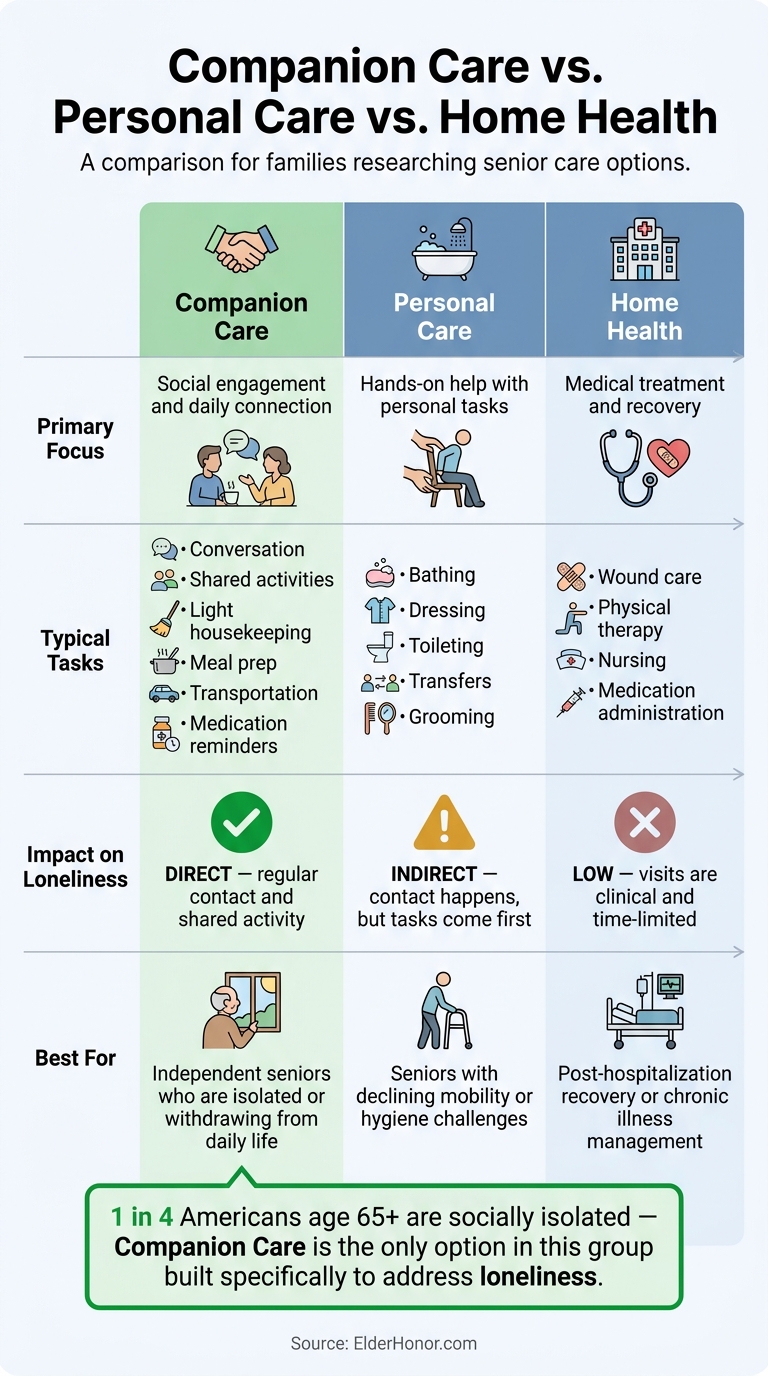
Companion Care vs. Personal Care vs. Home Health: Which Does Your Parent Need?
Once companion care comes up, families still have to match the service to the actual problem.
That matters because not every kind of in-home support does the same job. Companion care is meant to help with loneliness and day-to-day connection. Personal care is for hands-on help. Home health is for medical care.
Companion care usually includes conversation, errands, light housekeeping, meal prep, and transportation. Personal care covers bathing, dressing, toileting, and transfers. Home health is for wound care, rehab, and medication administration.
| Companion Care | Personal Care | Home Health | |
|---|---|---|---|
| Primary Focus | Social engagement and daily tasks | Hands-on personal tasks | Medical treatment and recovery |
| Typical Tasks | Conversation, shared activities, light housekeeping, meal prep, transportation | Bathing, dressing, toileting, transfers, grooming | Wound care, physical therapy, nursing, medication administration |
| Impact on Loneliness | Direct – regular contact and shared activity | Indirect – contact happens, but tasks come first | Low – visits are clinical and time-limited |
| Common Use Case | Independent seniors who are isolated or withdrawing | Seniors with declining mobility or hygiene challenges | Post-hospitalization recovery or chronic illness management |
If loneliness is the main issue, companion care is the only option in this group built to provide steady social contact.
Companion care and personal care often cost about the same. So the choice should come down to need, not price.
When companion care fits best for addressing loneliness
This is where the difference becomes clear: the parent is safe at home, but more and more alone.
Companion care makes sense first when a parent is medically stable, mostly independent, and socially isolated. The clearest fit is someone who can still handle basic self-care but rarely leaves home, sees few people, or has started to pull back from daily life.
If a parent also needs help with bathing or dressing, companion care can still play a part. It can work alongside personal care for hands-on tasks and home health when a medical issue calls for it. In plain terms, each service should do its own job. Social connection shouldn’t be left to chance.
When loneliness is the problem, companion care is the service built to address it head-on.
Conclusion: A direct way to reduce loneliness at home
About 1 in 4 Americans age 65 and older are socially isolated. That’s where companion care can help.
Companion care is a simple, practical response. It brings steady, nonmedical human contact into the home. And it works for one plain reason: it builds dependable connection into a parent’s weekly routine.
Adult children don’t have to wait until something goes wrong. Loneliness often grows little by little, well before a fall, a hospital stay, or clear cognitive decline. Starting with just a few visits each week is a light, flexible step. If needs shift over time, care can shift too. That’s why planning early matters.
If your family needs help starting the conversation or getting care organized, ElderHonor offers tools and coaching for planning and next steps. Companion care gives older adults regular connection at home.
FAQs
How often should companion care visits happen?
There’s no one-size-fits-all rule here. The right schedule depends on your parent’s needs, health, and the support they already have around them. Companion care can be set up for a few hours each week, every day, or even as a live-in arrangement.
What matters most is consistency. A steady, predictable routine often helps more than an irregular burst of visits. For social connection, a good starting point is at least three interactions per week, then adjust over time based on how your parent responds.
How do I know if my parent needs companion care or personal care?
Look at whether your parent can handle day-to-day life on their own. Start with ADLs, such as bathing, getting dressed, using the toilet, eating, and moving around safely. Then check IADLs, which cover the tasks that keep a household running, like taking medications the right way, making meals, paying bills, and keeping track of appointments.
Some warning signs point to a need for more help. Falls that happen more than once, mix-ups with medications, poor hygiene, missed meals, stacks of unpaid bills, or signs of memory loss can all signal that living alone is getting harder. In many families, these changes show up little by little, which makes them easy to brush off at first.
ElderHonor offers resources and coaching to help families figure out what kind of support is needed and how to plan care with a clear head.
Can companion care help if my parent won’t admit they’re lonely?
Yes. Companion care can still help, even if your parent doesn’t want to say they feel lonely. A lot of older adults turn down help out of pride or because they want to keep their independence.
It often helps to talk about care in terms of their goals. For example, you can frame it around aging in place and staying at home longer, instead of focusing on loneliness.
You can also start small. Light support, such as cleaning or meal delivery, often feels less intimidating at first. Over time, that kind of help can build trust and make other support feel more natural.