
If you’re caring for a parent with dementia, a faith community can help most when it offers organized, hands-on support – not only prayer or kind words.
I’d sum up the article this way: adult children caring for a parent with dementia often carry about 31 hours of care each week on average, and many deal with high stress, depression, and isolation. Faith communities can ease some of that load when they provide support groups, respite help, rides, meals, home visits, and simpler worship settings. But help often falls short when leaders lack dementia training, spaces are hard to use, or no one is clearly in charge.
Here’s the article in plain terms:
- The problem: Dementia caregiving can take over work, family life, and rest.
- Why faith communities matter: Many families already trust clergy and people in their congregation.
- What gets in the way: Stigma, little training, confusing worship spaces, and no clear system for help.
- What tends to work:
- caregiver support groups
- respite ministries
- memory cafés
- shorter, simpler worship
- meals, rides, and home care teams
- Why trust matters: In some communities, especially many Black church communities, church is often the first place families turn.
- What caregivers can do next: Ask direct questions, look for dementia-aware ministries, and build a written care plan that includes church support and outside services.
A faith community helps most when it is welcoming, steady, and clear about who does what.
Creating Dementia Friendly Faith Communities
sbb-itb-48c2a85
Where Faith Communities Fall Short for Dementia Caregivers
Many congregations care a great deal about families living with dementia. The problem is that care alone doesn’t always turn into support people can use. In many churches, synagogues, mosques, and other faith settings, the missing pieces are training, clear systems, and spaces that work for both caregivers and the person they support.
When Congregations Want to Help but Do Not Know How
Most clergy and volunteers get broad pastoral care training. But dementia often gets little attention, if any. That gap matters. Without even basic knowledge, a pastor or volunteer may read repetitive questions, wandering, or loud outbursts as rudeness, confusion, or intentional behavior instead of signs of the condition itself. When that happens, caregivers often stop asking for help.
A 2025 scoping review found that limited clergy training, scarce resources, and dementia stigma are common barriers to faith-based support. That leads to more than simple confusion. It creates uneven support from one family to the next. One person checks in often, while another goes silent. After a few experiences like that, many caregivers decide it’s easier not to reach out again.
There’s a system problem too. Many congregations don’t have:
- one person assigned to support caregiving families
- a clear follow-up process after a family shares a diagnosis
- a simple way to coordinate help such as rides or meals
Assigning one main contact can ease a lot of stress. It keeps families from juggling multiple texts, calls, and side conversations just to get basic help.
Why Standard Worship and Fellowship Can Become Hard to Access
Even kind and well-meaning congregations can make participation hard when worship services and gathering spaces are not set up with dementia in mind. A 60- to 90-minute service with standing, sitting, and dense liturgy can be too much for someone with dementia. Bright lights, loud sound systems, and hard-to-follow layouts can add agitation or create safety concerns.
Caregivers know this before they even walk through the door. They may worry that their loved one will get disoriented, try to leave in the middle of the service, or say something that draws stares. A 2020 study in an African American church context found that embarrassment, uncertainty about behaviors, and fear of stigma were key reasons families stopped attending church, and participants recommended education, better lighting, accessible parking, and clear directional signs.
Fellowship time after the service can be just as hard. Coffee hours and small groups often move fast. People talk over one another. The pace assumes quick social back-and-forth, which dementia slowly takes away. If a person repeats the same story or pulls back from the group, others may not know what they’re seeing. That misunderstanding can edge families out of the social life of the congregation.
For many caregivers, the choice starts to feel harsh: bring a loved one to worship and brace for stress, or stay home and avoid the strain. The table below shows the gap between a standard worship setting and one that works better for families living with dementia:
| Standard Worship Setting | Dementia-Friendly Approach |
|---|---|
| Long, complex services | Short, simple services with a clear structure |
| Assumes quiet stillness | Accepts calling out, wandering, or restlessness with flexibility |
| Small-print or text-heavy materials | Large-print, high-contrast materials |
| Unclear navigation and clutter | Clear signage, good lighting, and obstacle-free pathways |
| Attendance-only participation | Home, facility, or adapted worship when needed |
These barriers often push families to the edges of congregational life. They also show why dementia-friendly support needs to be practical, not just well meant.
How Faith Communities Can Offer Real, Practical Support
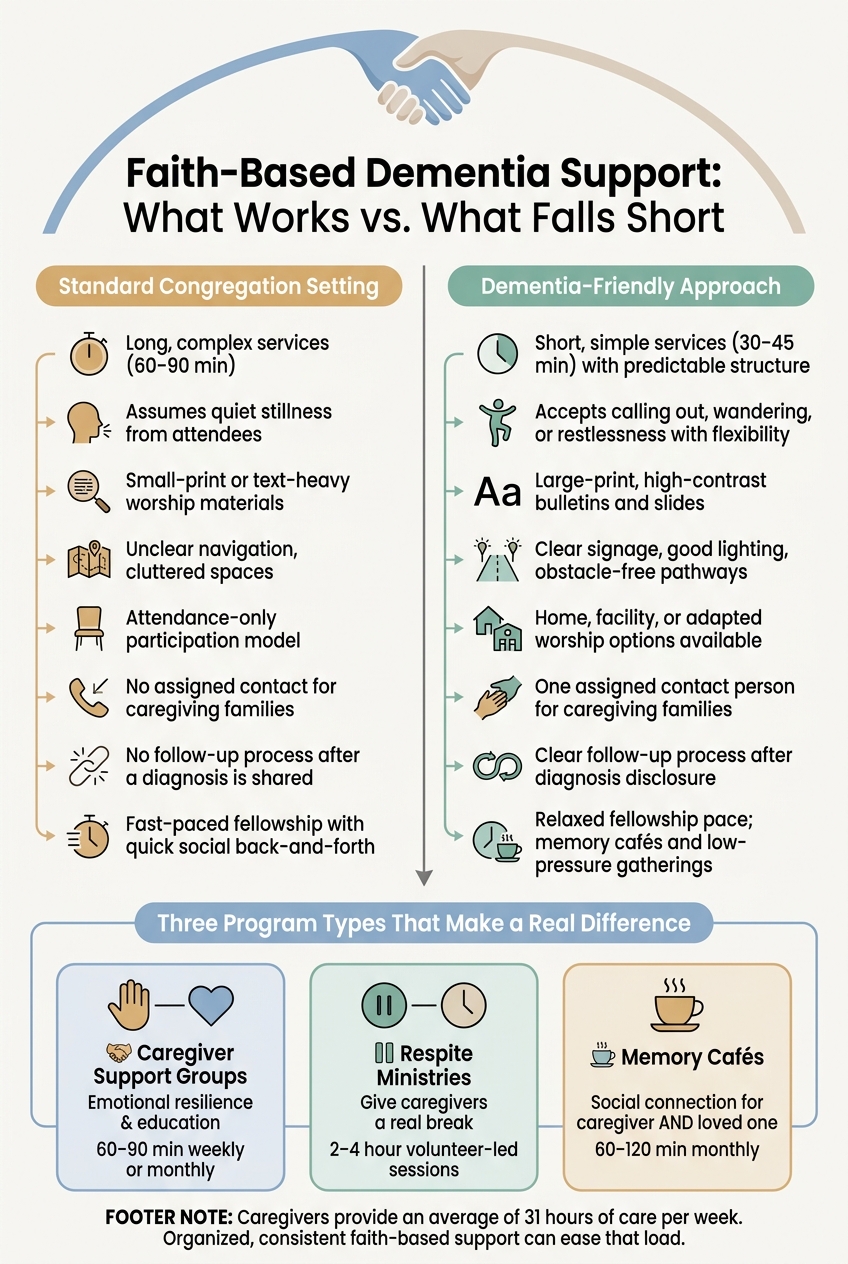
Faith-Based Dementia Support: Standard vs. Dementia-Friendly Worship Settings
Real support has to be steady, organized, and shaped around what families actually need. The good news is that many of the biggest barriers have simple fixes that congregations can keep up over time.
Support Groups, Respite Ministries, and Memory Cafés
Three program types stand out as strong places to begin: caregiver support groups, respite ministries, and memory cafés. Each one helps in a different way.
Support groups give caregivers a steady place to speak plainly about exhaustion, grief, and choices that can feel impossible. A solid group might meet once a month or every other week. It can start with a short reflection or prayer, include a brief teaching segment on dementia topics like communication tips or sundowning, and then move into open discussion. Many congregations rely on outside materials and facilitator training.
Respite ministries meet a more immediate need: they give caregivers actual time off. Screened volunteers spend time with the person with dementia through music, simple crafts, or conversation, either at the church or in the home, while the caregiver rests or runs errands. A church-led respite ministry in Montgomery, Alabama, became a model for this kind of program and showed that a volunteer team can ease anxiety and help families stay at home longer.
Memory cafés work a little differently because caregivers and their loved ones attend together. The setting is relaxed and low-pressure, often with familiar songs, light snacks, simple activities, and a nonjudgmental atmosphere. For many families, that shared time can ease isolation.
| Program Type | Primary Goal | Typical Activities | Caregiver Time Commitment | Who Usually Leads It |
|---|---|---|---|---|
| Caregiver Support Group | Emotional resilience and education | Discussion, prayer, dementia education | 60–90 minutes weekly or monthly | Clergy, lay leader, or social worker |
| Respite Ministry | Give caregivers a real break | Music, crafts, conversation | Drop-off and pickup; often a 2–4 hour break | Trained volunteer coordinator |
| Memory Café | Social connection for both caregiver and loved one | Singing, reminiscence, refreshments | 60–120 minutes monthly | Lay team, sometimes with a dementia specialist |
Dementia-Friendly Worship and Pastoral Care
Adapting worship does not mean starting from scratch. Shorter services, around 30 to 45 minutes, with a predictable order can make it much easier for people with dementia to stay oriented without feeling overloaded. Familiar hymns often help because musical memory can stay strong even in moderate dementia. Large-print bulletins, clear high-contrast slides, and easy-to-read signs for restrooms and exits can head off confusion before it builds.
Trained ushers matter more than many churches realize. When greeters know how to quietly help a disoriented person, guide a family to seating near an exit, or step in calmly if someone becomes agitated, the whole experience changes. A quiet room or side chapel with audio from the main service can also help families stay connected to worship without the strain of sitting through the full service in the main space.
Pastoral care tends to work best when it is steady and low-pressure. A short monthly phone call or text can remind a family that they have not been forgotten. Home visits from clergy or trained lay visitors can mean even more for caregivers who cannot easily leave the house. Those visits may include communion, brief readings, and honest conversation. They also give clergy a chance to notice when a family’s needs have changed.
Worship support helps families stay connected. Day-to-day life often needs the next layer of care.
Meals, Rides, and Care Teams That Ease Daily Strain
Meals, rides, and care teams can take pressure off the daily grind of appointments, transportation, and meal planning. A single meal drop-off is kind, but it does not last. What helps more is a rotating schedule where volunteers sign up ahead of time, follow clear rules on delivery times and food needs, and keep visits short unless the caregiver wants more company.
Transportation is another area where churches can make a big dent. A ride ministry that covers medical appointments, adult day programs, and worship services removes one of the most common practical barriers for dementia families. Volunteers should be screened for driving safety and given basic orientation on helping someone with cognitive and mobility issues. A central coordinator keeps the system from falling apart.
Lay care teams can tie all of this together. Short, scheduled home visits of 30 to 60 minutes might include simple companionship, light household help, or sitting with the person with dementia while the caregiver steps out. The word scheduled matters. Last-minute help is hard to count on, and dementia caregiving does not stop when coverage disappears.
| Strengths of Congregation-Led Support | Limits to Keep in Mind |
|---|---|
| High trust: Long-term relationships provide continuity that paid aides often cannot match | Volunteer capacity: Helpers can become overwhelmed, especially in smaller congregations |
| Spiritual fit: Prayer, shared values, and faith language add meaning that clinical services do not offer | Uneven resources: Support quality varies widely depending on congregation size and budget |
| Low or no cost: Critical for families managing significant out-of-pocket care expenses | Training gaps: Without dementia education, well-meaning volunteers can misread behaviors or overstep |
| Flexible and relational: Can respond quickly to crises outside of office hours | Not a substitute for clinical care: Medication management, skilled nursing, and legal planning require licensed professionals |
Start small if needed. One support group and one hands-on service can go a long way, as long as both stay consistent. Small, steady programs tend to help more than big plans that disappear after a few months.
Making Faith-Based Support More Responsive to Diverse Families
Why Faith-Integrated Support Matters in Diverse Communities
Faith-based support doesn’t land the same way in every community. Families come with different histories, expectations, and ways of asking for help. But one thing stays the same: people respond best to support that fits their values and the people they already trust.
For many African American families, the church isn’t a backup option during a health crisis. It’s the first place they go. In church-based samples of Black dementia caregivers, more than 90% said they stepped into caregiving for religious reasons or as a way to give back to family.
When programs miss that context, they can feel out of touch. By contrast, faith-aligned programs often feel more welcoming from the start. They may open with prayer, use worship language people hear every week, and talk about caregiving in terms that feel familiar. That kind of fit can support steady attendance and deeper participation.
Trust plays a big part here too. For African American communities, past healthcare harm has left deep scars. Historical abuses such as the Tuskegee Syphilis Study created justified skepticism toward healthcare institutions. So when support is offered in a familiar church setting, led by trusted pastors or lay leaders, outside help can feel less risky and more approachable.
Faith communities can also help chip away at dementia stigma. If memory loss is quietly treated as weakness or even spiritual failure, families may wait too long to get help. Churches can push back on that idea through sermons, group teaching, and trusted voices that name dementia for what it is: a brain disease, not a moral failing.
Once that trust is there, the congregation can do more than comfort families. It can help connect them to care beyond the church walls.
How Faith Communities Can Connect Families to Outside Education and Health Resources
Congregations can serve as a bridge to outside education when trusted leaders partner with local experts. A simple detail can make a big difference: if a pastor introduces the speaker and stays in the room during Q&A, caregivers who might have tuned out are more likely to listen, ask questions, and follow up later.
Faith-specific framing also helps people stay engaged. Information about dementia symptoms, stress management, and legal planning tends to land better when it’s shared in spiritual language, in familiar spaces, and through relationships people already trust. That can support stronger participation over time.
Faith support works best when it leads to clear next steps. One practical move is to keep an updated list of local services and share it in church bulletins or announcements. Many caregivers simply don’t know what’s out there. Useful referrals may include:
- Adult day programs
- Respite care
- Caregiver training
These kinds of connections matter because support is often most needed at the exact moment families feel stretched thin.
For harder planning choices around housing, finances, and end-of-life wishes, ElderHonor can add structure alongside what a congregation already offers. A caregiver might go to a church support group for spiritual grounding, use ElderHonor’s tools for aging in place and estate planning, and then talk through the family and faith side of those decisions with a pastor.
That trust can become the first step toward a stronger care plan.
How to Find Faith-Based Help and Build a Stronger Care Plan
Questions to Ask Your Congregation and Signs of a Supportive Ministry
Start with your congregation’s bulletin, website, or ministry calendar. Look for terms like “caregiver support,” “visitation,” “health ministry,” or “respite care.” Those words often point to help that’s already in place, even if it isn’t promoted much.
Next, set up a short call or meeting with clergy or a lay leader. Ask if the congregation offers caregiver support, respite during services, and help with meals or rides. Being direct helps. Clear questions tend to lead to clear answers, and they also show leaders what kind of support you need.
A congregation is often ready to help when it does a few simple things well:
- It notices when members stop attending and checks in
- It has an organized system for volunteer help
- It keeps an updated list of local resources, such as adult day programs or memory care facilities
- It includes access features in worship spaces, like large-print materials, quieter seating areas, and well-lit walkways
Those access features matter more than people sometimes think. They can show that the congregation has put real thought into the needs of people dealing with memory loss, sensory strain, or both.
Using ElderHonor to Turn Congregational Support into a Family Care Plan

Once you know what your congregation can do, build the rest of the care plan around that support. Congregational help can cover the local, relationship-based side of care. ElderHonor can help organize the bigger picture. Use a planning tool to sort out roles, write down needs, and track follow-up before meeting with clergy.
When families document needs in a clear way, faith-based help is easier to coordinate and keep going. ElderHonor’s coaching and online courses can also help caregivers get ready for harder family talks, like conversations about driving, home safety, or hospice, in ways that fit the family’s faith commitments. The aim is a written plan that families can return to as needs shift, with congregational support built into it.
Conclusion: Faith Support Works Best When It Is Practical, Welcoming, and Consistent
Congregations that pair structured programs – support groups, respite ministries, and dementia-friendly worship – with steady day-to-day contact can make a real difference in a caregiver’s life. Start by identifying what your congregation can offer, give people clear roles, and put the plan in writing.
FAQs
How do I ask my church for dementia caregiving help?
Start by asking whether the church has an organized visiting program or a volunteer ministry. That gives you a better starting point than leaning on one or two people and hoping they can carry the load.
It also helps to send requests through one main contact. One point person can keep things clear, pass updates along, and help avoid mix-ups. From there, reach out to the church community as a whole, not just a small circle.
Be specific about the kind of help you need. For example:
- Prayers
- Meals
- Companionship
- Spiritual support
That kind of clarity makes it easier for people to step in and help in a way that fits.
At the same time, set fair limits. Volunteers can often help with care, presence, and support, but they shouldn’t be expected to handle complex medical or financial decisions.
What makes a faith community dementia-friendly?
A dementia-friendly faith community can give the caregiving network steady, unpaid support that works alongside medical care. That support might look simple, but it matters: organized visits, shared meals, and a regular spiritual presence that helps the person feel connected and less alone.
Just as important, the community needs to respect each person’s limits and communicate clearly so support stays coordinated instead of chaotic. It should also honor the parent’s spiritual traditions through familiar prayers, hymns, and meaningful religious objects that can bring comfort and a sense of home.
Can faith-based support replace professional dementia care?
No. Faith-based support does not replace professional dementia care.
Faith communities can offer companionship, spiritual comfort, and social connection. That kind of support matters. It can help a person feel less alone and give families a sense of care around them.
But it’s still a supplement to professional care. Dementia brings complex physical and cognitive needs that faith-based support alone can’t meet. Medical care, memory care facilities, and trained home aides are still needed.