
Telehealth can help family caregivers most in the short term. I found that it can lower stress, cut some travel time, make follow-up visits easier, and help adult children stay in the loop. But the upside often drops off after 4 to 12 months, and setup problems can turn a simple visit into extra work.
If I had to sum up the article in a few lines, it would be this:
- Stress and burden often go down during the first few months
- Caregiver confidence can improve, especially with coaching or education
- Time savings are real, but only if the tech works well
- Care coordination often gets easier with direct online contact
- Access improves for rural, homebound, or long-distance families
- Long-term results are mixed
- Program design matters a lot: simple tools tend to work better
A few numbers stand out:
- About 63 million Americans are family caregivers
- Working caregivers spend about 27 hours per week on care tasks
- 67% report missing work or cutting hours because of caregiving
- In one study, 82% of homebound older adults needed caregiver help to finish a telehealth visit
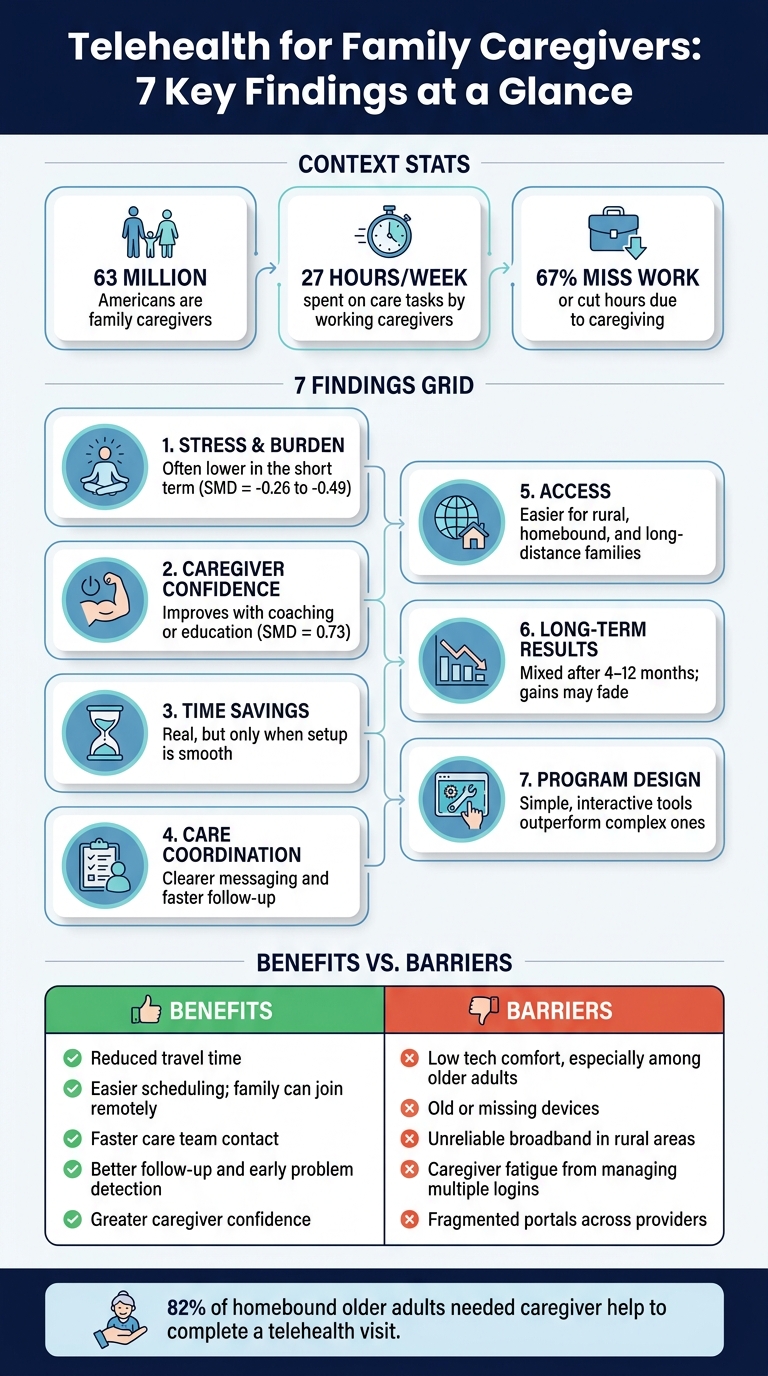
Telehealth for Family Caregivers: 7 Key Findings at a Glance
Caregiver Counseling | How to Find Personalized Online Family Caregiver Support for Elderly Care
sbb-itb-48c2a85
Quick Comparison
| Finding | What I see in the research | Main limit |
|---|---|---|
| Stress and burden | Often lower in the short term | Effects may fade later |
| Confidence | Often improves with support | Not every program includes coaching |
| Time | Can save travel and scheduling time | Logins, devices, and weak internet can eat up that gain |
| Care coordination | Messaging and follow-up can be clearer | Too many portals can create more work |
| Access | Easier for rural, homebound, and long-distance families | Broadband and device gaps still block use |
| Long-term effects | Less clear after 4–12 months | Many gains stop being statistically clear |
| Program design | Simple, interactive tools tend to do better | Hard-to-use systems add strain |
If you’re helping a parent, the plain takeaway is simple: use telehealth for follow-ups, medication reviews, and care-plan talks – not for urgent symptoms or visits that need a hands-on exam.
7 Research Findings on Telehealth for Caregivers
The clearest pattern in the research is simple: telehealth tends to help most in the short term.
Finding 1: Telehealth Can Lower Short-Term Caregiver Stress and Burden
Across multiple reviews, telehealth is linked to lower caregiver burden and stress over the short run. A 2025 meta-analysis found that within 4 months, telehealth reduced caregiver burden compared with usual care (SMD = −0.26; p = 0.01) and improved psychological well-being (SMD = 0.21; p = 0.006). A 2024 meta-analysis also found lower burden (SMD = −0.49; p < .001) and lower anxiety (SMD = −0.23; p = .009) among informal caregivers using telemedicine.
The same pattern showed up in dementia care. A 2026 meta-analysis found lower burden, depression, and stress among dementia caregivers, although anxiety did not improve in a statistically significant way. In many cases, these short-term gains appear when telehealth includes structured check-ins, psychoeducation, and symptom guidance.
Finding 2: Telehealth Can Improve Caregiving Confidence
When stress eases, confidence often follows. Research suggests telehealth can help caregivers feel more able to manage care, not just less overwhelmed. Reviews often report better caregiving confidence when programs include coaching, education, or direct clinician access.
A 2025 meta-analysis found a strong short-term improvement in caregiving competence (SMD = 0.73; p = 0.007). A 2022 meta-analysis focused on dementia caregiving found better self-efficacy, and a 2023 updated review reported gains in confidence and resiliency. In day-to-day life, that can mean feeling more prepared to handle medication issues, behavior changes, and routine care choices without waiting for the next appointment.
Finding 3: Telehealth May Save Time, but Setup Can Reduce Those Gains
Telehealth can save travel time and make follow-up visits easier to fit into a workday. But that upside isn’t automatic.
Setup can chip away at those time savings. Device setup, portal logins, audio or video issues, and weak internet connections can all slow things down – especially when a caregiver is also trying to help an older parent get online. So the time benefit often depends on how smooth the setup is. When the tech works well, communication tends to get easier too.
Finding 4: Telehealth Can Improve Care Coordination
Remote visits can make communication more direct. When updates, questions, and follow-ups happen online, caregivers often get clearer answers and faster next steps.
Reviews have reported better clinician-caregiver communication, clearer care plans, and stronger alignment across providers and family members. That matters a lot after a hospital discharge or a medication change, when waiting several days for a callback can feel like forever.
Finding 5: Telehealth Can Make Visits Easier to Access
For rural families, homebound older adults, and people with mobility limits, getting to a routine appointment can be a major hurdle. Telehealth removes much of that hassle.
Routine follow-ups, medication reviews, and symptom checks can happen without arranging a ride or leaving home. It also makes it easier for adult children to join from another location, which can help families stay on the same page.
Finding 6: Long-Term Results Are Mixed
This is where the research gets less clear. The main issue is whether the gains last.
The 2025 meta-analysis found that over 4–12 months, telehealth only showed a statistically significant improvement in managing a patient’s behavior problems (SMD = −1.27; p < 0.0001). At longer follow-up, effects on caregiver well-being, anxiety, depression, and burden were no longer statistically significant. A 2024 meta-analysis found the same kind of limit, with no significant effects on depression or quality of life. Put plainly, the gains may fade when support doesn’t continue.
Finding 7: Results Depend on Program Design and Ease of Use
Telehealth is not one thing. Some programs work far better than others, and the difference often comes down to design.
The research points to interactivity, tailoring, and ease of use as major drivers of results. Programs that are simple to use and built around caregiver needs tend to do better than generic platforms. When the technology feels clunky or there’s no support, telehealth can turn into one more chore instead of a source of help.
Where the Evidence Is Clear and Where It Falls Short
Where the Evidence Is Strongest
Taken together, the studies point to a simple pattern: telehealth tends to help most when it removes hassle instead of adding more steps. The strongest support is for short-term caregiver relief. One meta-analysis of digital technology-based caregiver interventions found moderate short-term drops in both burden and stress (Cohen’s d ≈ −0.65 and −0.62).
The weaker part of the evidence shows up in outcomes that need to last. Long-term mental health, quality of life, and physical health results are less consistent and less often tracked. In a palliative care telehealth review, all studies that measured caregiver quality of life found no significant difference compared with usual care. A meta-analysis focused on caregiver self-efficacy found no statistically significant difference in burden, stress, depression, or quality of life, even when confidence improved.
That gap matters. Caregivers don’t just need a smoother first few visits. They need support that still helps weeks and months later. And when families are deciding if telehealth makes sense for a given caregiving setup, those limits can carry a lot of weight.
Common Benefits vs. Common Barriers
In day-to-day use, telehealth often gives with one hand and takes with the other. A visit can save a long drive, then turn into extra work at home. The same pattern shows up in the research. In one study of homebound adults, 82% needed caregiver help to complete a telehealth visit. So in many cases, the caregiver isn’t just there for support. They’re also acting as the tech helper.
The table below puts that evidence into plain terms: what telehealth tends to deliver, and where it can create new strain.
| Common Benefits | Common Barriers |
|---|---|
| Reduced travel time and transportation costs | Low comfort with technology, especially among older adults |
| Easier scheduling; adult children can join from work or home | Old devices or missing cameras/mics |
| Faster contact with care teams | Unreliable broadband, especially in rural households |
| Better follow-up and earlier problem detection | Caregiver fatigue from managing logins, alerts, and entries |
| Greater caregiver confidence and skills | Multiple portals and logins across providers |
The next section turns these patterns into practical steps for adult children.
How Adult Children Can Apply These Findings to Real Caregiving
When Telehealth Is Most Likely to Help
These findings matter most when telehealth is used for the right type of visit.
Use telehealth for routine follow-up, medication review, and care planning, not urgent symptoms or visits that need a hands-on exam. It works well for follow-ups after a hospital discharge, chronic condition check-ins, and specialist consultations when the specialist is out of town. For adult children living in different cities, this can make life a lot easier. Multiple siblings can join the same video call, hear the care plan straight from the provider, and split up follow-up tasks right then and there.
Rural families often depend more on family caregiving, but broadband gaps can still make telehealth harder to use on a steady basis.
Telehealth also has hard limits. Urgent symptoms like chest pain, sudden confusion, trouble breathing, or signs of stroke call for emergency care, not a video visit. The same goes for a sudden loss of mobility or an inability to get out of bed. In those cases, an in-person exam, labs, or imaging are often needed to figure out what’s going on.
How to Prepare for a Better Telehealth Visit
When telehealth is a good fit, preparation often decides whether the visit saves time or creates more work.
Before the visit, pull together:
- An updated medication list
- A short symptom log
- 3 to 5 questions
It also helps to test the internet, camera, and microphone the day before. After the visit, write down each next step in plain English. Then assign every task to one person and give it a due date. That small step can prevent the all-too-common problem where everyone thinks someone else is handling it.
Where ElderHonor May Fit Into a Broader Care Plan
Families that need help getting organized can use caregiving support alongside telehealth.
ElderHonor’s toolkit and coaching can help families manage care conversations, aging-in-place planning, end-of-life decisions, and estate tasks alongside telehealth follow-up.
Conclusion: Key Takeaways From the 7 Findings
The evidence points in one clear direction: telehealth tends to help family caregivers most in the short term. It can lower stress and caregiver burden while making access and care coordination easier.
Over time, though, the picture gets less clear. Long-term results are mixed. After about 4 to 12 months, gains in stress, burden, and mood often start to fade.
Why does that happen? A lot of it comes down to design and delivery. Telehealth works best when the tech is easy to use, caregivers have help when they need it, and the virtual visit fits into the patient’s existing care plan instead of sitting off to the side.
For adult children helping a parent, the smart move is to use telehealth with care. It’s often a good fit for:
- Follow-ups
- Medication reviews
- Care-plan discussions
Hands-on exams still belong in person. And when families need help keeping everything straight, ElderHonor can help organize questions and follow-up tasks around telehealth visits.
Telehealth is a practical tool, not a full answer. Its value for caregivers is real, but it depends on using it for the right type of care, with simple systems and steady support.
FAQs
How do I know if telehealth is right for my parent’s next visit?
It depends on the kind of visit your parent needs.
Telehealth is often a good fit for routine follow-ups, medication reviews, or talks about test results when your parent is stable. In those cases, a video or phone visit can do the job just fine.
But if the visit calls for a physical exam or a procedure that can’t be done from home, an in-person appointment is usually the better choice. The same goes if your parent has new symptoms or anything that feels concerning and needs a hands-on check.
Your parent’s care plan, current medication list, and condition list can help you and the doctor figure out which option makes the most sense.
What should I do if telehealth creates more work instead of saving time?
If telehealth is adding to your workload, it helps to stop reacting to every new task and start planning ahead. That’s where ElderHonor comes in. Its C-A-R-E framework gives caregivers a clear way to handle what’s in front of them: Conversations, Assessments, Roadmap, and Education.
Simple, organized tools can take a lot of pressure off. A medical history file keeps key details in one place. A structured appointment map helps you prepare for visits without scrambling at the last minute. Together, those tools can cut down on repeat tasks and reduce the back-and-forth of chasing missing information.
And if you still feel stuck, ElderHonor also offers coaching and a private community for extra support.
How can I make telehealth benefits last longer for my family?
Move beyond one-off appointments by making telehealth part of a written care plan. ElderHonor can help you organize your parents’ medical needs, so you can ask better questions during visits and keep track of follow-up tasks.
It also helps to assign clear family roles for scheduling, joining visits, and handling provider recommendations. That way, the workload doesn’t fall on one person, and telehealth becomes easier to use as a long-term form of support.