
A gift can cut state inheritance tax – but only if it clears the state’s time rule. In this article, I’d boil it down to one question: Was the gift made early enough before death? In Pennsylvania, gifts made within 1 year of death are usually pulled back in, above the $3,000 per-recipient yearly exclusion. In New Jersey, gifts made within 3 years of death are often treated as death-related, especially for non-exempt heirs like siblings, nieces, nephews, and friends.
Here’s the short version:
- Inheritance tax, estate tax, and federal gift tax are different
- Pennsylvania uses a 1-year look-back
- New Jersey uses a 3-year look-back
- Who gets the gift matters a lot in New Jersey
- Bad records can leave the executor with a tax problem
- A gift can save state tax but create capital gains or Medicaid issues
- Cash flow for future care matters just as much as tax savings
A few numbers show why timing matters:
- In Pennsylvania, a $200,000 gift made 6 months before death can still be taxed, with only the first $3,000 per recipient left out
- In New Jersey, a gift to a friend may face 15% to 16% inheritance tax if it falls inside the 3-year window
- Federal gift tax reporting may start once gifts go over the annual exclusion, even if no federal tax is due
| State | Look-back period | Main issue |
|---|---|---|
| Pennsylvania | 1 year | Gifts within 1 year may be added back, above $3,000 per recipient per year |
| New Jersey | 3 years | Gifts within 3 years may be treated as death-related for non-exempt heirs |
My takeaway is simple: gifting can work, but only when the state rule, the recipient, the asset type, and the parent’s care budget all fit together. If those pieces don’t line up, the tax move can backfire fast.
The Core Problem: Why Gifts Do Not Always Remove Assets From Tax
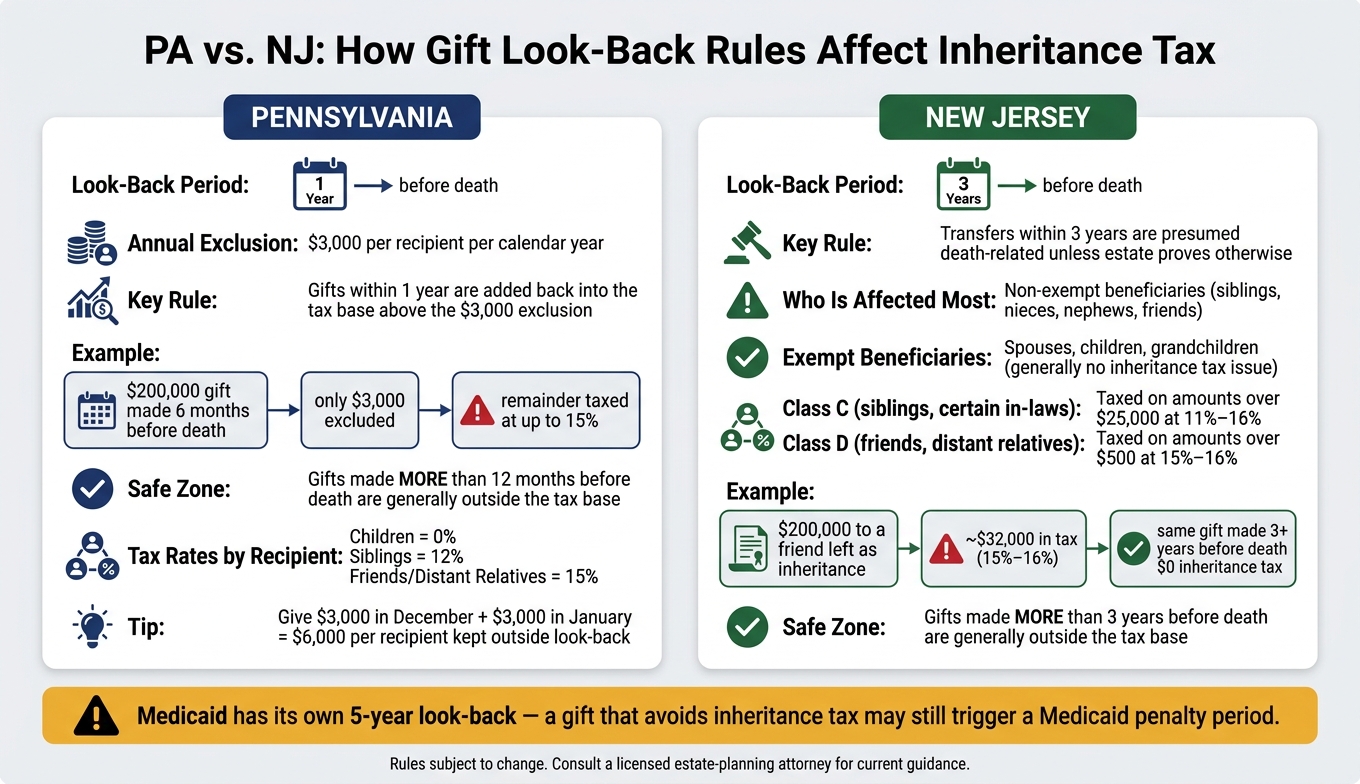
PA vs NJ Inheritance Tax Gift Rules: Look-Back Periods & Tax Rates
Giving money or property away does not always take it out of the tax picture.
If the donor dies during a state’s look-back period, that gift can still count for inheritance-tax purposes. Neither Pennsylvania nor New Jersey charges a separate state gift tax when the transfer happens. But both states have rules meant to stop deathbed gifting from cutting down the taxable estate. So even a completed gift may be pulled back into the tax base if death happens during that window.
Pennsylvania uses a one-year look-back period. New Jersey uses a three-year period.
Pennsylvania and New Jersey Have Different Gift Look-Back Rules
Pennsylvania’s rule is fairly short. Gifts or transfers for less than full consideration made within 12 months of death are included in the inheritance tax base, except for the first $3,000 per recipient per calendar year. That can make a big difference. Say someone gives $200,000 six months before death. Only the first $3,000 per recipient stays outside the tax base, and the rest is included and taxed at 15%. If that same gift is made more than one year before death, it is usually outside the Pennsylvania inheritance tax base.
New Jersey takes a different path. Transfers made without adequate consideration within three years of death are presumed to have been made in contemplation of death, unless the estate can prove otherwise. In plain English: the state starts from the position that the transfer was death-related.
Who gets the gift matters a lot in New Jersey. Gifts to exempt beneficiaries – such as spouses, children, and grandchildren – generally do not create inheritance tax issues. But gifts to non-exempt beneficiaries, including siblings, nieces, nephews, and friends, may still be taxable if they fall inside the three-year window. Within that period, gifts over $25,000 to Class C beneficiaries are taxed at 11% to 16%. Gifts over $500 to Class D beneficiaries are taxed at 15% to 16%.
| State | Look-Back Period | Key Rule | Who Is Most Affected |
|---|---|---|---|
| Pennsylvania | 1 year before death | Gifts within one year are included above the $3,000 per-recipient per calendar year exemption | Recipients who would otherwise be subject to Pennsylvania inheritance tax |
| New Jersey | 3 years before death | Transfers without adequate consideration within three years are presumed to be death-related unless the estate proves otherwise | Non-exempt beneficiaries |
Poor Documentation Can Create Problems for the Executor
Time is only part of the story. Paperwork matters too.
This shows up all the time when adult children help with bills or get paid for caregiving. Those transfers can be hard to sort out because they may look like compensation, reimbursement, gifts, or an advance on inheritance, depending on what records exist. Same money, very different tax treatment.
That puts pressure on the executor. Executors must identify transfers made during the look-back period and report them the right way. If records are missing or patchy, taxable transfers can appear larger than they were.
A simple gift ledger can save a lot of trouble. Track:
- date
- amount
- recipient
- relationship
- purpose
- bank records or canceled checks
That kind of basic recordkeeping can make it much easier to show what each transfer was meant to be.
sbb-itb-48c2a85
How Gifts Can Lower Inheritance Tax in Key States
Once the look-back rule is clear, the next step is simple: did the gift happen early enough before death to stay out of the tax calculation? That answer depends on the state.
Pennsylvania: Gifts Made More Than One Year Before Death May Reduce Taxable Transfers
Pennsylvania does not have a gift tax. And in most cases, gifts made more than one year before death are left out of the inheritance tax base.
That rule applies no matter how large the gift is. For families helping a parent shift assets while care costs and monthly cash needs are still under control, that can make a big difference.
Here’s what that looks like in practice:
- A parent who gives $150,000 to an adult child 14 months before death owes no Pennsylvania inheritance tax on that transfer.
- The tax gap is bigger for other recipients. Siblings face a 12% rate, and friends or more distant relatives face 15%.
- So if someone gives $100,000 to a friend 13 months before death instead of leaving it as an inheritance, the family avoids about $15,000 in Pennsylvania inheritance tax.
There’s also one small rule that can help at the margins. Pennsylvania allows a $3,000 per-recipient annual exclusion, and that amount can be split across two calendar years. In plain English, a person could give $3,000 in December and another $3,000 in January to the same recipient and keep $6,000 per recipient outside the look-back rule.
New Jersey works from the same general idea, but the timing window is longer and the recipient’s class matters more.
New Jersey: Gifts to Non-Exempt Beneficiaries May Be Added Back if Made Within Three Years of Death
New Jersey may add back gifts made within three years of death. But whether tax is due depends on who received the gift.
Gifts to exempt relatives are usually outside the tax. Gifts to siblings, friends, and other non-exempt recipients are a different story. Class C beneficiaries, such as siblings and certain in-laws, are taxed on amounts over $25,000. Class D beneficiaries, including friends and more distant relatives, may owe tax on amounts over $500.
A good example shows the stakes. If a New Jersey resident gives $200,000 to a friend and lives for three years, that transfer may come out of the inheritance tax base entirely. Leave that same $200,000 as an inheritance instead, and it would be taxed at 15% to 16% as a Class D transfer, or about $32,000.
If the donor does not survive the full three years, New Jersey treats the transfer as death-related and taxes it that way. Executors also have to report transfers made within three years of death, even if they think no tax is due.
The tricky part is that other inheritance-tax states use different clocks, so the same gift can lead to a very different result somewhere else.
Other States With Inheritance Tax Require a State-Specific Review
State rules shift often. Because of that, families should check current guidance from the state revenue department or talk with a local estate-planning attorney before relying on older planning ideas.
A rule that worked a few years ago may not work now. And if the wrong rule gets applied, the result can be extra tax, extra reporting, or both.
Trade-Offs, Reporting, and When Gifting Can Backfire
Even if a gift avoids inheritance tax, that doesn’t mean it’s automatically a smart move. Once the gift is past the look-back period, the focus shifts. Now you’re dealing with federal reporting, tax basis, and future care costs. In plain English: the goal isn’t just a lower tax bill. It’s a better overall result.
Federal Reporting and Basis Issues Can Offset State Tax Savings
Gifts above the annual exclusion may require Form 709 reporting. Most families won’t owe federal gift tax because taxable gifts first reduce the donor’s unified lifetime gift and estate tax exemption – $13.99 million in 2025 and $15 million in 2026. Still, Form 709 can add cost, paperwork, and hassle. And every reportable gift chips away at that lifetime exemption.
The bigger problem often isn’t timing. It’s what you give away.
For example, gifting appreciated property can cut state inheritance tax but pass the built-in capital gain to the child. If the child sells soon after, that sale could produce a large capital-gains tax bill. If that same property had passed at death instead, the basis would step up to fair market value. In many cases, that can wipe out the capital gain.
That’s why a tax-saving gift can turn into a bad deal. You save on one side, then lose money on the other.
Gifts Can Affect a Parent’s Cash Flow, Long-Term Care, and Family Dynamics
A gift also shrinks the assets left to support the parent. If someone gives away too much, they may later need help from the same children they were trying to help in the first place.
There’s also a major Medicaid issue here. Even if a gift is outside a state inheritance-tax look-back, Medicaid has its own five-year look-back for nursing home coverage. A gift that helps with inheritance tax now can create a penalty period of Medicaid ineligibility later. That can mean paying privately right when care is most expensive. These rules run on different clocks, and mixing them up is a costly mistake.
Family issues matter too. Unequal gifts can spark conflict, especially if no one explains them. Without records or a clear family discussion, those transfers can become a flash point after death. Missing documentation can also make it harder for the executor to defend the gift and can open the door to undue influence claims.
When Gifting Helps and When It May Hurt: A Side-by-Side Comparison
Seeing the trade-offs next to each other makes the pattern easier to spot.
| Scenario | Likely Outcome |
|---|---|
| Cash gift made outside state look-back period | Reduces inheritance tax; no basis issue; straightforward to document |
| Appreciated asset gifted outside look-back period | Reduces inheritance tax but transfers embedded capital gain to child |
| Gift made inside state look-back period | May be pulled back into the inheritance tax base; federal reporting may still apply |
| Gift to non-exempt beneficiary outside look-back | Can avoid 15%–16% inheritance tax on Class D transfers |
| Large gift that depletes parent’s reserves | May force dependence on children; Medicaid eligibility at risk if care needed soon |
| Unequal gifts among siblings without documentation | Risk of family conflict, executor disputes, or undue influence claims |
The best setup is usually pretty simple: cash gifts to non-exempt beneficiaries, made well outside the look-back window, while the parent still keeps enough for future care. On the other hand, gifting often works poorly when the asset has a low basis, the parent doesn’t have much left in reserve, or Medicaid could become an issue in the near term. That’s why gifting usually makes more sense as one part of a larger estate plan, not as a one-shot tax move.
Conclusion: Use Gifts as Part of a Larger Estate and Caregiving Plan
After you sort through the tax rules, reporting duties, and care trade-offs, the next step is simple: decide whether a gift still makes sense for the family plan.
Lifetime gifts can cut state inheritance tax, but only in some cases. The state’s look-back rule has to line up. The right recipient matters. And the paperwork needs to be solid.
Tax savings don’t mean much if a parent can’t still pay for care. If a gift gets past the look-back window but leaves a parent short on cash for assisted living or in-home care, that’s not a good outcome. The same goes for a transfer that saves tax on one side but creates a bigger capital gains bill on the other. Gifting only works when it fits the care plan, the estate plan, and the family’s day-to-day cash needs.
Key Takeaways for Adult Children Helping Aging Parents
If you’re helping a parent, start by checking three things: the state rule, the asset being transferred, and the parent’s cash position.
- Confirm the exact look-back rule before making any transfer. Pennsylvania and New Jersey do not use the same rules, and in New Jersey, the recipient’s class can change the result.
- Check basis before gifting appreciated property. Keep records for every transfer, including dates, amounts, recipients, and copies of any filed Form 709 returns. That gives executors what they need to apply exemptions the right way and respond if a transfer is ever questioned.
- Compare tax savings with care costs. Care bills can outgrow the tax saved in a hurry, so a tax move should never weaken the parent’s financial floor.
The best gift plan should sit inside a bigger caregiving and estate plan, not operate as a one-off tax move.
FAQs
Does a gift always lower inheritance tax?
No. Lifetime gifts may help with inheritance tax, but they can also cause problems for long-term care planning.
If a parent later applies for Medicaid, the state reviews asset transfers made in the prior 60 months. Any gifts made during that five-year look-back period can trigger a penalty period. During that time, Medicaid won’t pay for care, which means the family may have to cover those costs out of pocket.
Which gifts are most likely to be taxed in Pennsylvania or New Jersey?
In Pennsylvania and New Jersey, the gifts most likely to create major money problems are the ones made during Medicaid’s look-back period. That period covers the 60 months before someone applies for Medicaid.
Why does that matter? Because those gifts can trigger a penalty period. During that time, the state won’t pay for long-term care.
This rule is tied to Medicaid eligibility, but families shouldn’t stop there. It also makes sense to talk with an elder law attorney about each state’s inheritance tax rules and transfer laws, since Pennsylvania and New Jersey can differ in ways that affect what happens next.
Could gifting now create tax or Medicaid problems later?
Yes. Gifting now can cause serious Medicaid problems later.
Medicaid has a 5-year look-back period. During that window, it reviews asset transfers such as gifts, below-market transfers, and large unexplained withdrawals.
If Medicaid finds that assets were transferred during that period, it may impose a penalty period. That means Medicaid can refuse to pay for long-term care for a set amount of time.
The length of that penalty depends on two things:
- The amount transferred
- The state’s average monthly nursing home cost