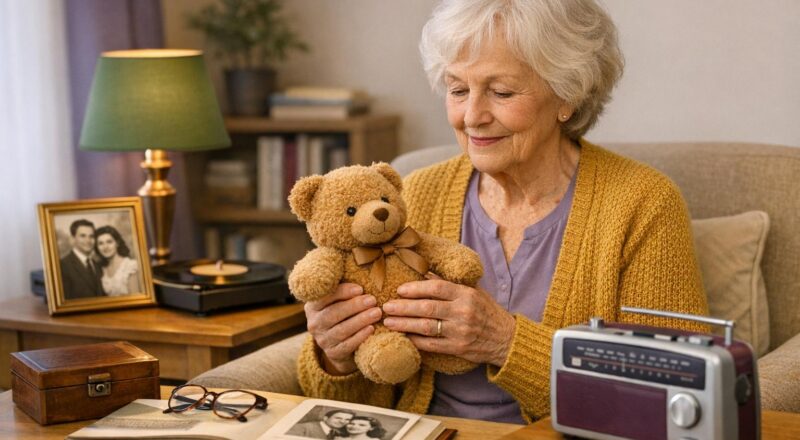
A favorite chair from sixty years ago can do something a Xanax can’t.
The science is real, but the experience is what catches families off guard. Your parent enters a stage of dementia where rooms become unfamiliar even when nothing has been moved. People they’ve known their whole lives don’t always register. Words for everyday objects slip away. Then someone hands them a small worn quilt, or sets a familiar mug on the table, or plays a song they danced to seventy years ago — and the agitation softens. The shoulders drop. Something in them recognizes something, even when nothing else seems to.
This post is about that recognition. Why familiar objects matter so much for people with dementia, what kinds tend to work, how to build a “comfort kit” for your parent, and how to use familiar objects to ease the moments that otherwise become difficult.
If you haven’t read it, the foundational read on communication: Best Words and Phrases for Dementia Communication.
Why familiar objects work.
Memory in dementia isn’t lost evenly. The most recent memories tend to fade first; long-ago memories often persist far longer. Items from your parent’s young adulthood, childhood, or early married life sit in the part of memory that lasts the longest. A wedding photo, a high school sweater, a family Bible, the smell of a particular perfume — these are accessible long after recent events disappear.
Familiar objects also bypass cognitive processing. Your parent may not be able to think about the object, but their body recognizes it. Familiarity is a felt experience, not just a remembered one. That’s why the right object can lower agitation in moments when nothing said in words seems to land.
The neuroscience supports what caregivers see. Procedural and emotional memory systems in the brain remain comparatively intact in dementia long after declarative memory fades (Alzheimer’s Association — Stages and Behaviors). The body remembers what the mind has forgotten.
What kinds of objects tend to work.
Five categories that consistently produce calming and connecting effects:
1. Photographs. Old family photos — especially from your parent’s young adult years, wedding, raising-children years — almost always reach. Frame a few. Make a small album. Even better: a photo book with pictures and one-line captions that don’t test memory. “Your wedding day, 1962.” Not “do you remember this?”
2. Textiles and clothing. A favorite robe, a quilt, a worn sweater, a soft blanket. The texture and familiarity work even when the visual recognition has faded. A fragile parent who gets agitated in unfamiliar settings often calms when wrapped in something they recognize by touch. Many memory care residences encourage families to bring “comfort textiles” for exactly this reason.
3. Music from young adulthood. This is one of the most powerful interventions in dementia care. Songs from ages 15–25 in particular are linked to procedural and emotional memory and tend to remain accessible far longer than other content. Music can reach a parent who hasn’t responded to words in days. Build a playlist of their music. Use it in transitions, during agitation, before bed.
4. Scent and small comforts. A particular hand cream, a favorite tea, a familiar soap. Scent reaches deeper memory than almost any other sense. A whiff of the perfume your mom wore your whole childhood can connect her — and you — in a moment where words are failing.
5. Touched objects of significance. Wedding ring, watch, a favorite Bible, a worn cookbook, a piece of jewelry from a special occasion. Items they handled often have their own emotional weight and physical familiarity. Sometimes the simple act of holding it brings calm.
What kinds of objects to avoid.
Not every object is helpful. Some can produce the opposite of what you intended:
- Items associated with traumatic memory — old letters from a difficult relationship, photos of someone with whom there was conflict, items from a period of grief or hardship.
- Anything fragile or sharp. As coordination declines, breakable or sharp objects become safety hazards.
- Items that confuse rather than orient. A photo with a deceased spouse may produce grief rather than comfort. A memento of a child no longer alive may trigger distress. Test gently.
- Anything that isn’t theirs. “This was your mother’s“ doesn’t reach the way “this is yours, and has been” reaches. The personal connection matters.
- Sensory overload combinations. Too many objects at once, too many photos, too much music — calmer is usually better than more. One or two well-chosen items beat a room full of mementos.
Building a comfort kit.
For families navigating moderate to advanced dementia, assemble a small “comfort kit” of objects you can pull from in different moments. Caregivers in memory care settings often build these for residents; you can build one for home or facility care.
Suggested contents:
- A small photo album with 10–15 well-chosen pictures
- One favorite textile — a small blanket, scarf, or worn shirt
- A familiar small object — a watch, a piece of jewelry, a paperweight
- A music playlist — phone, simple speaker, or pre-loaded device
- A scent — small bottle of a favorite cologne or hand cream
- A familiar food or beverage — comfort tea, a favorite candy, a particular brand they’ve always liked
- A spiritual or religious item if applicable — a prayer card, a rosary, a hymn book
- A small task object — something to fidget with, fold, sort. (See the sensory tools post for more on this.)
Keep the kit in a single bag or box accessible at home or available to bring to facility visits or hospital stays.
How to use familiar objects through the day.
Different moments call for different objects. Patterns:
Morning routines. A familiar mug for coffee, the same playlist each morning, the same robe — predictability and familiarity in the morning hours often make the rest of the day go better.
Transitions. Moving from one place to another — into a car, out of a car, into a new room — is often a moment of disorientation. A familiar object held during the transition gives the parent something stable to anchor to.
Doctor visits and medical settings. Hospitals, clinics, MRI machines — high-stress environments. Bring the comfort kit. A favorite blanket, photographs, a music playlist on headphones can dramatically reduce distress.
Mid-afternoon agitation (sundowning). Many people with dementia experience increased agitation in the late afternoon. A predictable comfort routine — same chair, same music, same blanket, same beverage — helps the body settle into a more calm state.
Bedtime. A familiar nightgown or pajamas, a specific bedside arrangement, the same closing music or prayer. Predictability soothes.
Visitors. When other people visit and your parent doesn’t recognize them, having familiar objects in view (their own quilt on their own chair, their music playing, their photos visible) helps anchor them in their own world even as new people enter it.
Care moments — bathing, dressing. Many people with dementia resist these moments. A favorite scent, a warm towel, soft music can ease the resistance.
When the parent is no longer at home.
For parents who have moved into memory care or assisted living, familiar objects become even more important. The new environment is unfamiliar by definition; familiar objects provide continuity.
Specific suggestions for facility transitions:
- Bring a few specific items — favorite chair if possible, photographs, a quilt, a small lamp from home, a favorite book or two. Most facilities welcome these.
- Recreate one corner. Even if the room has institutional furniture, a corner with familiar items creates a “home zone” the parent recognizes.
- Familiar bedding. A pillow from home, the parent’s own sheets, a favorite blanket. Touch and scent matter for sleep.
- Photo wall. Family pictures visible from the bed and the chair. Captioned photos work better than uncaptioned for some residents.
- Music in the room. Many facilities allow personal speakers or headphones. The parent’s playlist is one of the best-spent setup investments.
Facilities that specialize in memory care often suggest exactly this kind of personalization. Lean into the recommendation.
When something stops working.
Familiar objects that worked yesterday may not work today. Some patterns:
- Disease progression changes what reaches. As dementia advances, more items may be needed, simpler items may work better, or different categories of object (more touch-based, less photo-based) may become more effective.
- The parent may form new associations. A specific blanket may become “the bath blanket” — soothing in the bath but stressful elsewhere. Watch for these patterns.
- Some objects become triggers for grief or agitation. If a photo of a deceased family member produces grief each time, rotate it out. Loving the parent now is more important than displaying every photo.
- New objects can sometimes work better than old ones. A simple new soft blanket may reach where an heirloom doesn’t, if the heirloom carries complicated emotion. Familiarity is the goal; specific provenance is secondary.
“A favorite chair from sixty years ago can do something a Xanax can’t. The body remembers what the mind has forgotten.”
FROM TWO PARENTS WHO RESPONDED TO DIFFERENT THINGS:
Both my mother and my stepmothers had Alzheimer’s, and the objects that reached each of them were different.
For my mom, the thing that reliably reached her was music from her young adulthood. The big-band era. Songs she’d danced to in her early twenties. Late in her decline, when most words had become difficult, she’d still hum along to those songs. Sometimes she’d close her eyes and look like she was somewhere I couldn’t go — but somewhere good. Music carried her where words couldn’t.
For my stepmother, the thing that reached most reliably was photographs. Specific ones — her with my dad, on a vacation they’d taken in their fifties. Her grandchildren when they were small. A small photo album we kept on her bedside table was something she’d return to without prompting, again and again. Some days she could tell us about the people in the photos. Other days she just held the book. Both seemed to comfort her.
What I learned across both parents: the right object isn’t a category — it’s a specific thing tied to a specific period of their life that the disease hasn’t yet reached. Sometimes you’ll find it on the first try. Sometimes it’ll take a year of trying things to find what reaches. Both are normal.
The other thing I learned: the right object often does more than the right medication. Not always — sometimes medication is necessary and helpful. But for the agitation, anxiety, and disorientation that fill so many hours of dementia caregiving, familiar objects often calm faster, more deeply, and with no side effects. They are some of the best tools families have, and they’re free, and they’re already in the house.
Honor is in the name of our company for a reason: ElderHonor. Honoring our parents includes meeting them with the things that have always meant something to them — the song, the photograph, the worn blanket, the familiar mug. The disease takes a lot. It doesn’t take everything. The objects that still reach are the doorways that stay open.
Where to start today.
If your parent is in early-stage dementia:
- Identify three to five items that hold strong personal significance — and that they still recognize.
- Build a small “comfort kit” with these items.
- Build the music playlist now while you can ask them what songs mattered. Don’t wait — preferences are easier to confirm while the parent can tell you.
- Photograph items in current rooms so future caregivers (or your future self) know what each item is and where it goes.
If your parent is in moderate or advanced dementia:
- Observe what reaches. Test gently — bring different items, watch responses, build the kit around what works.
- Bring the kit everywhere — facility visits, doctor appointments, hospital stays, day programs.
- Rotate items if they stop working. Some items lose effectiveness; some gain it. Stay flexible.
If your parent is moving to memory care or assisted living:
- Recreate a corner of home in the new room. Familiar chair, lamp, photos, quilt.
- Talk to facility staff about personalization and their experience with what works.
- Visit with the comfort kit — bringing familiar objects from home into the new environment maintains continuity.
You’ve got this. The right object can do more than you’d believe.
The toolkit’s Caring for Yourself and Conversations modules walk through the daily-care frameworks, the comfort-kit checklists, and the relational practices that keep your parent connected to their own life across the long arc of dementia — built so the small things can keep doing their big work.
Some additional articles that might be helpful, some have already been listed above.
- The Best Words and Phrases for Dementia Communication post — already linked inline; communication companion.
- The How Sensory Tools Help Calm Dementia Patients post — companion on tools.
- The How to Build Emotional Bonds with Dementia Patients post — relational layer.
- The Cognitive Stimulation Activities for Early Dementia post — early-stage activities.
- The How to Choose Activities for Late-Stage Dementia post — late-stage activities.
- The Alzheimer’s series — David’s foundational dementia content.
- Resource Library — specifically Alzheimer’s Association, Teepa Snow entries.
Additional notes:
The “music memory preserved in dementia” framing is supported by neuropsychological research but the magnitude varies by individual and stage.
The “procedural and emotional memory remain intact” framing is broadly supported but selective in advanced disease.
The “comfort kit” framing is editorial — not a clinical term. Different caregiving frameworks call this different things.
The “Xanax comparison” quote is rhetorical, not clinical, it’s used only as a reference and does not imply results.
Back to the Caregiver Library. Read more on Dementia & cognitive care.