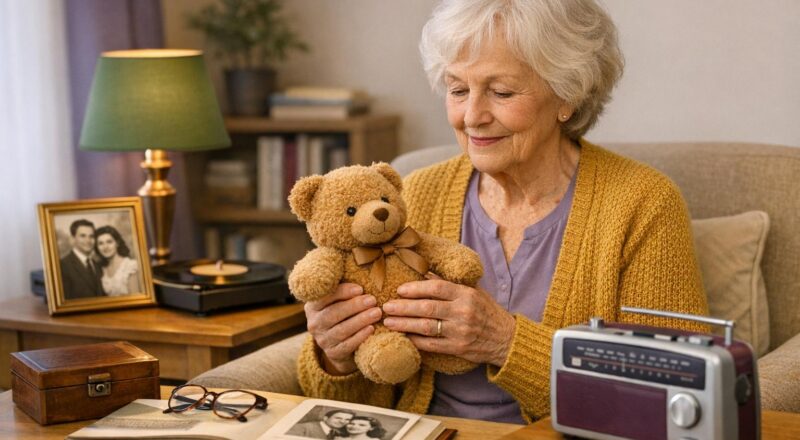
Sometimes the answer to a hard moment is something you can hold.
Verbal interventions have limits. When your parent is mid-agitation, when sundowning starts, when a transition is going badly, the right words may not exist. The body is asking for something the mind isn’t yet able to articulate. A tactile, sensory tool — something to fold, something to feel, something to hum to, something soft against the skin — often does the work that words can’t.
This post is the practical companion to How Familiar Objects Help Dementia Patients Feel Safe. The two overlap; familiar objects are personal, and sensory tools are physiological. Some of the best sensory tools are familiar objects. Some are simple, generic, and surprisingly effective regardless of personal history.
If you haven’t read it, the foundational read on communication: Best Words and Phrases for Dementia Communication.
Why sensory tools work.
The autonomic nervous system processes sensation faster than the cognitive system processes language. By the time your parent’s brain is processing the words you’re saying, the body has already responded to the sensory input. A weighted blanket is calming the nervous system seconds before any conscious thought registers. A favorite tactile object is producing a “this is safe” response before the brain has caught up.
In dementia, this advantage compounds. Cognitive processing slows or fails; sensory processing often remains comparatively intact. Tools that work on the body work even when tools that work on the mind don’t.
The major sensory channels caregivers can engage:
- Touch — texture, weight, temperature, pressure
- Hearing — music, ambient sound, white noise, voice quality
- Smell — familiar scents, calming essential oils, baking smells
- Sight — soft light, predictable color, simple visual environments
- Taste — comfort foods, warm beverages, familiar tastes
- Movement — rocking, walking, gentle physical activity
Different parents respond to different channels. The work is figuring out which channels reach yours, and building tools and routines around them.
Touch-based tools that work.
Touch is the most reliably calming sensory channel for most people with dementia. Specific tools:
Weighted blankets and lap pads. A 5–15 lb weighted blanket (or a smaller weighted lap pad for sitting) provides gentle, deep pressure that stimulates the parasympathetic nervous system — the “rest and digest” mode. Many caregivers report dramatic reductions in agitation when a weighted blanket is introduced consistently. Look for ones with washable covers; expect to wash them often.
Fidget tools. Small handheld objects that invite gentle, repetitive manipulation:
- Twiddle muffs — knitted or crocheted muffs with various textures, beads, ribbons, and zippers attached. Designed for dementia care.
- Sensory blankets — small lap blankets with sewn-on attachments (buttons, zippers, soft patches, ribbons).
- Stress balls and squeeze toys — soft, palm-sized, gentle on hands.
- Worry beads or rosary beads — culturally familiar, repetitive motion.
- Smooth stones — palm-sized, calming weight, simple to hold.
Soft and varied textures. Faux fur, satin, terry cloth, soft cotton, fleece — all can be soothing. Some caregivers use a “texture board” — a small board with various fabric squares attached — for gentle exploration during calm moments.
Therapy dolls or stuffed animals. A small soft animal or dementia-specific therapy doll can become a profound source of comfort, particularly for women in later stages. Some caregivers feel uncomfortable about this initially — there’s a perception that the parent is being infantilized — but the comfort is real and the parent is the authority on what comforts them. Watch the response; let your parent guide.
Hand-holding and gentle touch from caregivers. Not technically a “tool,” but worth naming. Direct human warmth — a held hand, a gentle hand on the shoulder, sitting close on the couch — is one of the most powerful sensory interventions available. It costs nothing and reaches deeply.
Sound and music as sensory tools.
Music is often the most powerful single intervention in dementia care. Specifically:
Personalized music playlists. Songs from your parent’s young adult years (roughly ages 15–30) tend to remain accessible long after most other content fades. Build a playlist of 30–50 songs they love. Use it daily — at meals, during care moments, in transitions, before sleep.
Slow, ambient music. For agitation, slow, instrumental music (classical, soft jazz, nature sounds) can settle the nervous system without engaging cognition. Tempo matters — slower tempos calm; faster tempos energize. For evening agitation, slower is almost always better.
White noise or nature sounds. Some people with dementia respond to the soft constancy of rain, ocean waves, or white noise. Particularly useful for sleep.
Familiar voices. Recorded voices of family members — a grandchild reading a story, a daughter humming a familiar song, a husband saying “I love you” — can comfort during separations or care moments when the family member can’t be present.
Live or recorded singing. Many people with dementia retain the ability to hum or sing along to familiar songs long after speech becomes difficult. Singing together is one of the most connecting activities available.
Avoid: loud, fast-tempo, or unfamiliar music during agitation. News broadcasts (often distressing). Multiple competing audio sources at once.
Scent-based tools.
Scent reaches deeper into memory than almost any other sense. Useful applications:
- Familiar perfumes or colognes — a small bottle of what your parent has always worn can produce an immediate calming response.
- Lavender — well-researched for general calming effects. Sachets, essential oil diffusers (used carefully), pillow sprays.
- Familiar baking smells — cinnamon, vanilla, baking bread. A scented candle or simmering pot can fill a room with a comforting smell from your parent’s life.
- Coffee or tea aroma — for those whose mornings always involved one or the other.
- Citrus or peppermint — generally energizing and can help with mid-day fatigue.
Caution: essential oils should be used carefully. Diffusers are safer than topical application; some essential oils interact with medications or skin. Consult the doctor if your parent has respiratory conditions.
Visual tools and environment.
The visual environment shapes mood far more than caregivers often realize. Patterns:
- Soft, indirect lighting. Harsh fluorescent overhead lighting is agitating to many people with dementia. Lamps, indirect light, dim evenings.
- Reduced visual clutter. Busy environments overload the visual system. Calmer rooms produce calmer parents.
- Familiar visual landmarks. A specific chair, a particular painting, a recognizable corner — all provide visual anchors.
- Photographs at eye level. Visible without effort.
- Looking outside. Many people with dementia find watching birds, trees, weather, or street activity profoundly calming. A chair positioned by a window is one of the simplest interventions available.
- Aquariums or fish tanks. Research-supported as calming for many people with dementia. The slow, predictable movement and soft sound work together.
Avoid: busy patterns (highly patterned wallpaper, busy fabric), reflective mirrors that confuse (some advanced-stage patients see their own reflection as a stranger), and visually-noisy TV during calm hours.
Taste and food as sensory tools.
Familiar tastes anchor in deep memory. Specific applications:
- Comfort foods. A favorite cookie, a familiar soup, a particular tea — used not just for nutrition but for comfort.
- Sweet drinks. Many people with dementia respond especially well to sweet tastes; warm cocoa or sweetened tea can be soothing.
- Hand-held foods. Finger foods, fruit slices, small sandwiches — easier to manage than utensil-required meals as motor coordination declines.
- Routine and ritual around food. The same morning coffee, the same after-dinner tea. The ritual itself is calming, separately from the food.
Caution: swallowing difficulties (dysphagia) develop in some forms of advanced dementia. Texture-modified foods may be needed. Consult speech-language therapists or geriatricians if you’re observing coughing or difficulty swallowing.
Movement as sensory tool.
Gentle, predictable movement engages proprioceptive and vestibular systems and is calming for many people with dementia:
- Rocking chairs. The repetitive, gentle motion is profoundly calming for many people with dementia. A good rocking chair is one of the highest-leverage furniture investments in a memory care setup.
- Slow walking. A walk together — even a short one, even pacing inside the house — can settle agitation. The rhythm of walking organizes the body.
- Gentle hand massage. Lotion, soft hand contact, slow rhythmic motion. Another path that doesn’t require words.
- Dancing or swaying together. With music. Even seated. Even briefly.
Putting it all together — a sensory-rich routine.
For families navigating moderate to advanced dementia, a sensory-aware daily routine is one of the most impactful caregiving frameworks available. A simple version:
Morning: soft music, a familiar mug of coffee, gentle indirect light, the same routine sequence (washing, dressing, breakfast).
Mid-morning to mid-afternoon: activities that engage senses gently — folding laundry (touch, repetition), looking at photo albums (sight, memory), listening to music (hearing), looking out a window (sight, calm).
Late afternoon (sundowning window): lower lights, calming music, weighted blanket, a familiar object in their lap, perhaps a warm beverage. Avoid scheduling stressful activities or visits during this window.
Evening: quieter still, warmer light, simpler activities, familiar bedtime ritual.
Night, if waking: soft voice, familiar bedside item, gentle touch. Don’t introduce new stimulation.
The framework isn’t complicated. It’s the consistent application that makes it work.
“Verbal interventions have limits. The body is asking for something the mind isn’t yet able to articulate. Tools that work on the body work even when tools that work on the mind don’t.”
FROM THE TOOLS THAT REACHED:
Across both my mother and one of my stepmothers — both with Alzheimer’s — the sensory tools that reliably reached varied by person.
For my mom, the most powerful tool was music. Songs from her young adulthood, played on a small bedside speaker. Late in her decline, when conversations had become difficult, she’d close her eyes and sway to the music in a way that felt like the most present version of her in the room. The music wasn’t entertainment. It was access.
For my stepmother, the tool that calmed her most reliably was a soft blanket and her Bible, where she could reach them. She’d hold the blanket with one hand and the Bible with the other. Sometimes she’d flip through the Bible. Sometimes she’d just rest with both. The combination — touch and visual — settled her in moments when verbal reassurance didn’t.
What I learned across both: finding the tools that work for a specific parent takes experimentation. What soothes one person agitates another. What worked yesterday may not work tomorrow. The work is observation — what reduces tension, what increases it, what produces a smile, what produces withdrawal — and adapting.
The other thing I learned: simple is usually better than complex. A small soft blanket. A familiar mug. A 30-song playlist. A worn photo album. The expensive specialty tools have their place, but the most reliably effective tools are usually already in the house.
Honor is in the name of our company for a reason: ElderHonor. Honoring our parents includes meeting their bodies, not just their minds. The body holds the parent we still know — through touch, through music, through scent, through the small textures and rhythms that have been theirs for decades. The disease quiets a lot. It doesn’t quiet the body’s capacity to be reached.
Where to start today.
If you’re new to sensory caregiving:
- Pick three categories — one touch tool, one music intervention, one scent or visual change. Try them this week.
- Observe what works. Note which tools reduce agitation and which don’t.
- Build the routine. Once you find what works, embed it in the daily flow.
If you’re deeper in:
- Add the categories you haven’t tried yet. If you’ve been heavy on touch, try music or scent.
- Invest in a few specialty tools — a quality weighted blanket, a twiddle muff, a personalized playlist on a simple device.
- Recommend the toolkit to other caregivers — siblings, paid aides, facility staff. Consistent sensory care across caregivers compounds the benefit.
If your parent is in memory care or assisted living:
- Build the personalized sensory kit and bring it to the facility.
- Talk to facility staff about their experience with sensory interventions.
- Keep the kit accessible in their room — visible and easy to reach.
You’ve got this.
The toolkit’s Caring for Yourself and Conversations modules walk through the sensory-aware daily routine, the tool-selection framework, and the patterns that keep agitation low and connection high — built so the small interventions can do their daily work without burning the family out.
Some additional links that might be helpful:
- How Familiar Objects Help Dementia Patients — already linked inline; companion piece on personal objects.
- Best Words and Phrases for Dementia Communication — already linked inline; communication companion.
- How to Build Emotional Bonds with Dementia Patients — relational layer.
- Cognitive Stimulation Activities for Early Dementia — early-stage activity guide.
- How to Choose Activities for Late-Stage Dementia — late-stage activity guide.
- The Alzheimer’s series — David’s foundational dementia content.
- Resource Library — specifically Alzheimer’s Association, Teepa Snow, dementia-care product entries.
Some additional notes:
The “weighted blanket reduces agitation” framing is supported by occupational therapy practice and research in autism and anxiety contexts; specific dementia research is more limited. It may not work in your situation.
The “music memory preserved in dementia” reference is well-supported but the magnitude varies by individual. It actually worked with my Mom.
The “lavender for calming” reference has some research support but evidence for dementia-specific effects is limited. It may not work in your situation.
The “aquariums calming” reference draws from older research in nursing home settings; verify if you want a citation. It may not work in your situation.
Essential oil safety guidance is general; specific recommendations should defer to clinical guidance — particularly for parents with respiratory conditions, allergies, or on multiple medications. It may not work in your situation.
The “young adult years music memory” framing (ages 15–30) is supported by research but the exact range is approximate.
Therapy dolls are an area of professional debate. Some clinicians recommend them; others worry about infantilization. If you decide to try this, watch the response and let your parent guide as it may not work in your situation.
Back to the Caregiver Library. Read more on Dementia & cognitive care.