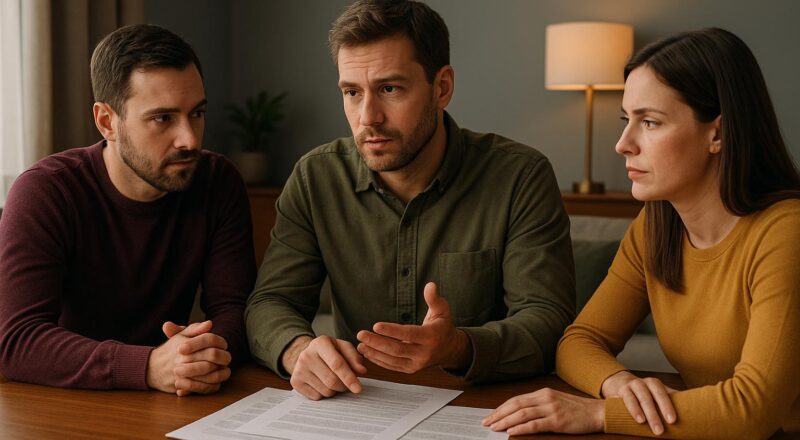
Adult children come to end-of-life planning with the same handful of questions, in different forms.
The questions are reasonable. They’re often unanswered because nobody in the family has been through this before, the medical and legal systems use language that doesn’t quite match the questions, and the emotional weight of the topic produces avoidance. The information is available. It just isn’t in one accessible place when families need it.
This post is that one place. The questions adult children most often ask about end-of-life planning, with direct answers and pointers to deeper reading.
For the timeline view of when this work happens, see End of Life Planning Timeline.
When do we need to start end-of-life planning?
Earlier than feels necessary. Most families wait too long.
The honest answer: estate documents and advance care planning should be in place by your parent’s mid-60s, ideally earlier. Conversations about preferences, values, and wishes should happen across decades, not in the final weeks. Hospice should be engaged when the prognosis warrants it — typically when curative treatment is no longer working or your parent has expressed a preference for comfort over aggressive intervention.
The signs that “now” is the right time to start (or accelerate) the work:
- Your parent has received a serious diagnosis
- A significant decline has happened
- Your parent has been hospitalized multiple times in the last year
- The family is approaching decisions that the existing documents don’t anticipate
- Your parent has expressed wishes that aren’t yet documented
If any of those apply, don’t wait.
What documents do we need?
The core five:
- Will or trust — directs distribution of assets at death.
- Durable Power of Attorney (DPOA) for finances — authorizes someone to manage finances if your parent becomes incapacitated.
- Health Care Power of Attorney (HCPOA) — authorizes someone to make medical decisions if your parent can’t.
- Living Will / Advance Directive — documents wishes about life-sustaining treatment.
- HIPAA Release — authorizes who can receive medical information.
For the deeper read, see Estate Planning Checklist for Adult Children.
Additional documents some families need:
- Revocable Living Trust — for asset distribution privacy and probate avoidance, when assets warrant it
- POLST or MOLST — Physician Orders for Life-Sustaining Treatment, where state law uses these
- Beneficiary designation forms — for retirement accounts, life insurance, etc.
- Special Needs Trust — for situations involving disabled beneficiaries
An elder law attorney is the right professional to draft and coordinate these. See Roles of Elder Law Attorneys in Caregiving.
What’s the difference between palliative care and hospice?
Palliative care is care focused on quality of life and symptom management for people with serious illness. It can be provided alongside curative treatment. A patient receiving chemotherapy for cancer can also receive palliative care to manage pain, nausea, and emotional support.
Hospice is a specific program — typically Medicare-covered — for patients with a prognosis of six months or less who have elected to forgo curative treatment in favor of comfort care.
Palliative care is broader and earlier. Hospice is narrower and later. Many families benefit from palliative care for years before they need hospice.
When should we call hospice?
Earlier than most families think.
The hospice benefit is for prognoses of six months or less. Most families wait until the final week or two. The data is consistent: patients admitted to hospice earlier have better symptom control, fewer hospitalizations in the final months, higher family satisfaction, and often longer survival than patients admitted in the final days (National Hospice and Palliative Care Organization, Facts and Figures).
Signs that the hospice conversation is overdue:
- The doctor has stopped recommending curative treatment
- Treatments aren’t working
- Your parent has expressed a preference against aggressive intervention
- Multiple hospitalizations in the past 6 months
- Significant decline in functional ability
You don’t need a doctor’s referral to call hospice. You can call a local hospice agency directly and ask for an evaluation.
For the deeper read, see Family Caregivers and Hospice Teams.
What does hospice actually do?
Hospice provides a comprehensive team:
- Hospice nurse (RN) — primary clinical contact; manages medications and symptoms
- Hospice physician — oversees care plan
- Hospice aide (CNA) — helps with bathing, personal care
- Social worker — practical and emotional support
- Chaplain — spiritual care if desired
- Volunteers — companion care, errands, respite for the family
- Bereavement counselor — supports the family before and after
Most hospice care happens at home, though it can also occur in nursing homes, assisted living, hospitals, or dedicated hospice facilities. Most costs are covered by Medicare or Medicaid for those who qualify.
What can we expect in the final weeks and days?
The trajectory varies by individual, but common patterns include:
- Decreased appetite and reduced food/fluid intake — natural; not a problem to solve
- Increased sleep and decreased responsiveness — gradual withdrawal
- Changes in breathing patterns — sometimes irregular, sometimes labored
- Changes in skin color and temperature — particularly in extremities
- Possible periods of restlessness or agitation — often manageable with medication
- Decreased pain in many cases as the body’s processes shift
Hearing is often preserved late. Talk to your parent. Tell them you love them. Play their music.
The hospice team prepares the family for what to expect and is available 24/7 for questions and concerns. Lean on them.
What do we do at the moment of death?
If hospice is involved, call hospice first, not 911. Hospice handles the death pronouncement and contacts the funeral home. Calling 911 in a hospice situation can produce confusion — emergency responders may attempt resuscitation if a DNR isn’t immediately visible.
If hospice isn’t involved, call the parent’s doctor or 911 depending on the situation.
Take the time you need. Many families want quiet time after death before the body is moved. There’s no rush. The funeral home will come when you call them, and the body can rest with the family for hours if that’s appropriate.
Where do most people die?
About 31% of Americans die at home. About 25% die in hospitals. About 24% die in nursing homes or long-term care. The rest die in hospices and other settings (CDC data; verify current figures).
The trend is toward more home deaths, partly due to growth in hospice. What matters more than the location is whether the death matched the parent’s wishes.
How do we plan a funeral or memorial?
Most families work with a funeral home, which guides:
- Body care decisions — burial, cremation, alternative options
- Service planning — religious or secular, location, structure, attendees
- Notifications and obituary
- Death certificates — typically order 5–10 originals
- Specific religious or cultural practices
Pre-planning is enormously valuable. Many funeral homes offer pre-arrangement programs that lock in pricing and document preferences. Pre-paid funerals can be tricky financially — talk to the elder law attorney about whether pre-payment is right for your situation.
If your parent has expressed specific wishes about their funeral or memorial, honor them. Even if some family members disagree, the parent’s expressed preferences should usually prevail.
What about cremation vs. burial?
Both are widely accepted. Specific religious or cultural traditions sometimes favor one. Cost varies — cremation is typically less expensive than burial. Environmental considerations vary by location.
Document your parent’s preference if they have one. This is one of the simplest preferences to capture and one of the more emotionally fraught moments to make on someone’s behalf without knowing their wishes.
How long does probate take?
For most estates, 6 to 18 months. Contested estates can take much longer. Estates that bypass probate (assets in trusts, beneficiary designations, joint tenancy property) can be administered much faster.
For the deeper read, see Probate Court Basics for Inheritance Disputes.
What if family members disagree about end-of-life decisions?
Painful, common, and addressable. Patterns:
- Honor what the parent documented. Living Will and HCPOA exist precisely for these moments.
- Bring in third parties. Doctors, hospice social workers, family mediators, chaplains.
- Slow the decisions where possible. Most end-of-life decisions don’t have to be made in seconds.
- Don’t escalate to legal battle if it can be avoided. Mediation is almost always better than litigation.
For the deeper read, see Why Siblings Fight Over Inheritance and How to Avoid It.
How does the family take care of itself through this?
Caregiver self-care during end-of-life caregiving is essential.
- Sleep matters. Even when it feels impossible.
- Eat real food. Not aspirational meal plans — regular, decent meals.
- Take shifts. No one person should be the only one present.
- Allow grief. It starts before death; it continues after.
- Connect with bereavement support. Hospice provides this for up to 13 months after death; therapists, support groups, and religious communities can extend it.
The toolkit’s Caring for Yourself module addresses this specifically.
What surprises families most?
A few patterns I’ve watched repeatedly:
- The relief alongside the grief. Many families feel guilty about feeling relief when a long illness ends. The relief is appropriate. It doesn’t diminish the grief.
- The intensity of the work in the final weeks. Families often underestimate how all-consuming the active dying period is.
- The aftermath. Estate work, notifications, paperwork, decisions — the post-death work continues for months.
- The grief arc. Anniversaries, holidays, smells, songs — grief surfaces unpredictably for years.
- The family relationships. Some families come closer through the experience; some fragment. The family that was working together before tends to stay together; the family that was struggling tends to struggle harder.
“Adult children come to end-of-life planning with the same handful of questions. The information is available — it just isn’t in one accessible place when families need it most.”
FROM FIVE GOODBYES THAT TAUGHT ME:
Across my parents and stepparents — five end-of-life experiences over the years — the patterns that held across all of them shaped how I understand this work now.
The endings that went best had a few things in common: early hospice engagement, family alignment, documents in order, conversations had while the parent could still participate, and presence in the final stretch. When those were in place, the family could focus on the parent and on each other rather than on logistics and disagreements.
The endings that were harder had things in common too: late hospice or no hospice, estate documents not current, family members not aligned, decisions getting made under pressure, the parent’s wishes unclear because nobody had asked while they could answer. None of those were anyone’s fault. They were the predictable result of the work not having been done earlier.
What I learned: the questions in this post are the questions every family eventually asks. The families that ask them years before the end have time to actually answer them. The families that ask them in the final weeks are doing the work in the wrong moment. The information is the same. The capacity to use it is wildly different.
One specific lesson that stayed with me: call hospice earlier than you think. I’ve watched many families wait until the final week, then express regret afterwards that they hadn’t engaged hospice sooner. The hospice teams I’ve worked with are some of the most skilled and compassionate people in the healthcare system. Their work in the final weeks and months is some of the highest-leverage care a family can access. Don’t wait until the runway is too short for them to do their best work.
Another lesson: trust the parent. When parents have communicated what they want — about treatment, about location, about presence, about everything — honor it. Even when family members disagree, even when professionals counsel something different, the parent’s expressed wishes are usually the right answer. That’s why the documents and conversations matter so much. They give the family permission to honor the parent rather than litigate the moment.
Honor is in the name of our company for a reason: ElderHonor. Honoring our parents at the end is the work of years, condensed by circumstance into the final weeks. The years matter. The conversations matter. The documents matter. The presence matters. None of it can be improvised at the end. Start now, whatever stage you’re in. The future self of your family will thank you.
Where to start today.
If your parent is healthy or in early decline:
- Get the five core documents in place within 90 days.
- Start the foundational conversations about wishes, values, and preferences.
- Build the medical history file so it’s ready when needed.
If your parent has had a recent serious diagnosis or significant decline:
- Engage palliative care if not already.
- Have the deeper conversations about specific scenarios.
- Verify documents are current.
- Discuss hospice timing with the medical team.
If you’re approaching active end-of-life:
- Engage hospice if not already.
- Lean on the hospice team for guidance.
- Be present. Trust the work you’ve done.
- Take care of yourself and the family.
You’ve got this.
The toolkit’s End of Life and Caring for Yourself modules walk through the question framework, the document checklists, the hospice-engagement timeline, and the family communication patterns that turn end-of-life caregiving into presence rather than scrambling — built so the family can be with the parent through the most important stretch.
Some additional articles that could be helpful:
- The End of Life Planning Timeline — already linked inline; companion piece.
- The Estate Planning Checklist — already linked inline.
- The Living Wills — already linked inline.
- The Family Caregivers and Hospice Teams — already linked inline.
- The Probate Court Basics — already linked inline.
- The Roles of Elder Law Attorneys — already linked inline.
- The Why Siblings Fight Over Inheritance — already linked inline.
- Resource Library — NHPCO, CaringInfo, Eldercare Locator entries.
Some additional notes:
CDC death-location statistics cited figures are illustrative.
The “31% home deaths” figure is illustrative; the trend toward home deaths is supported but specific percentages vary by geography.
Medicare hospice benefit (six-month-or-less prognosis) is federal and stable.
The “earlier hospice produces better outcomes” framing is supported by hospice research.
The “hearing preserved late” framing is from hospice practice; not strictly clinical.
The “31%” home death figure has been moving with COVID and post-COVID trends.
Pre-paid funerals are legally complex; verify state-specific guidance before committing to any agreements.
Back to the Caregiver Library. Read more on Building the plan.