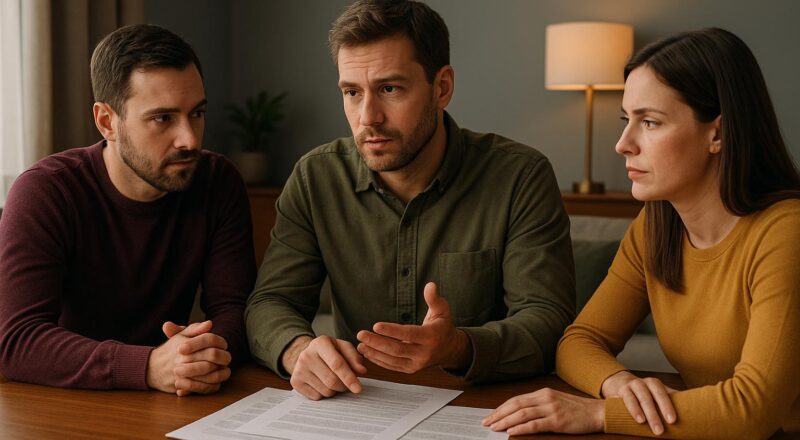
Here’s the part most articles about inheritance disputes miss: siblings don’t fight about money.
They fight about money. The fight is about money the way a family argument at Thanksgiving is about who set the table. The thing on the surface is real, but it’s standing in for something underneath that’s been there for forty years.
The thing underneath is usually some version of: who did Mom love most, who got more attention growing up, who stayed close, who moved away, who gave up parts of their life to help and who didn’t, who was acknowledged for it and who wasn’t. The will is the moment all of that becomes legible — written down, in dollars and houses and rings and accounts. The number on the page becomes the answer to a question the family never asked out loud.
This post is about that. The real reasons siblings fight about inheritance, the patterns that produce most of the conflict, and what families can do — both before and during the moment — to keep the legal moment from rewriting the relationships.
If you haven’t read it, the legal-mechanics companion: Probate Court Basics for Inheritance Disputes. This post is the human-dynamics version of the same problem.
What siblings actually fight about.
Five patterns surface in almost every contested estate I’ve watched or read about.
1. The caregiver-distance gap. One sibling did the heavy lifting — daily phone calls, hospital admissions, medication management, the cold rooms at 3 AM, the conversations with the discharge planner. The other siblings lived farther away, called less, helped less. When the will distributes equally, the caregiver feels punished. When the will distributes unequally, the distance siblings feel attacked. Both versions produce conflict. The version that doesn’t is the one where the family talked about it explicitly while the parent was alive — and the parent’s intent (and the recognition of the caregiver’s contribution) was clear before any document needed enforcing.
2. The “Mom always said” phenomenon. A specific item — the wedding ring, the dining room table, the cabin on the lake, the family photographs — that one sibling believes was promised to them. The other siblings remember either no such promise or a different one. None of those promises are in writing. When the will doesn’t address the item specifically, or addresses it differently than the verbal promise, the fight starts. Sometimes it’s the most expensive item. More often it’s the smallest sentimental thing.
3. Perceived favoritism, decades old. “You were always Dad’s favorite.” “Mom never forgave me for moving away.” “You got the wedding paid for; I didn’t.” The will becomes the venue for grievances that have nothing to do with the will. The distribution doesn’t have to actually be unequal — it just has to land in a family that already feels unequally loved.
4. Late-life relationships and step-family. A second marriage, a romantic partner late in life, step-children, half-siblings — any of these change the inheritance math in ways the original family didn’t expect. Children of a first marriage often feel that any assets going to a late-life spouse or step-children represent something taken from them. The fight tends to be more about identity (“who is the real family?”) than dollars.
5. The executor as proxy for the conflict. One sibling is named executor. The others now perceive every decision — sell the house or keep it, distribute the personal effects how, pay this debt or contest it — as biased. The executor, even when behaving cleanly, becomes the lightning rod for the underlying family conflict. Family-member executors face this scrutiny far more than professional executors do.
The thread connecting all five: the inheritance moment is the moment a lifetime of family dynamics becomes legible in a legal document. The will writes down what was previously only felt. The fight that follows is the fight the family has been having quietly for forty years, but couldn’t name.
What “fair” actually means.
A common assumption that produces most fights: that “fair” means “equal.” It often doesn’t.
Equal distribution divides the estate into identical shares for each beneficiary. It treats everyone as if they had identical relationships with the parent and contributed identically to the parent’s life. That’s almost never true. The caregiver who gave up career trajectory to help didn’t have the same relationship as the sibling who flew in twice a year. The sibling who borrowed $80,000 fifteen years ago and never paid it back didn’t have the same financial relationship as the sibling who didn’t.
Equitable distribution adjusts for those differences. The caregiver gets compensated for years of unpaid labor. The sibling who borrowed money has it deducted from their share. The disabled grandchild gets a Special Needs Trust. The college tuition the parent paid for one child counts against that child’s share if the parent intended it to.
Neither approach is right or wrong. What matters is that the parent decides which approach reflects their wishes, documents it specifically, and ideally talks to the family about it while alive. Equal distributions can be fair. Unequal distributions can be fair. Disputes happen when the family can’t tell which one the parent intended, or when the parent’s intent contradicts what the family expected.
Prevention. The conversations that work.
Most inheritance disputes are preventable. The patterns that prevent them, in order of leverage:
1. Talk while everyone’s alive. This is not a single conversation. It’s a series of conversations, over years, in low-stakes moments. “Mom, what’s most important to you about how things get distributed?” “Dad, do you want me to know what’s in the will so I can plan?” “Have you thought about how to handle the cabin?” The parents who answer these questions out loud, even imperfectly, produce families that don’t fight after they’re gone. The parents who keep everything private produce families that fight.
2. Address the caregiver-distance gap directly. If one sibling has done meaningfully more caregiving, the conversation about how that’s recognized — financially, in the will, or symbolically — should happen explicitly. Not by surprise in the document, but openly with all the siblings. The recognition can take many forms: an explicit additional bequest, a reimbursement clause, a written acknowledgment, a different distribution of personal effects. What matters is that everyone knew it was coming.
3. Document personal effects. Most fights I’ve watched about specific items would have been prevented by a one-page list with names next to objects. Mom’s ring → Sister. Dad’s watch → Brother. The dining room table → Local nephew. Most parents resist doing this, partly because it forces them to play favorites, and partly because the items don’t feel important enough to specify. They become important the moment the parent is gone. Write it down.
4. Consider a family meeting while the parent is alive. A facilitated conversation where the parent explains, in broad terms, what the plan is and why. Not a reading of the will. A statement of intent. “Here’s what I’m thinking. Here’s why. I want you all to hear it from me, not from the lawyer after I’m gone.” The mediator can be an elder law attorney, a family therapist, a financial planner, or a trusted friend. The version that works is one where the parent speaks; the version that doesn’t is one where the children speak for the parent in their absence.
5. Pick the executor for the relationships, not the resume. The right executor is responsive, even-handed, organized, and respected by all the siblings. Sometimes the most successful sibling is the wrong choice because of underlying family dynamics. Sometimes a professional executor (a bank trust department, an attorney) is the right call even though it costs more — because the neutrality is worth more than the savings. Talk to the parent about who they’re considering and why.
6. Update everything after life events. A new marriage, a divorce, a new child or grandchild, a death of a beneficiary, a major financial change — any of these calls for an estate review. A 25-year-old will that names an executor who has since passed away is worse than no will. So is a beneficiary designation that names a long-divorced spouse.
During the moment, if a dispute is starting.
If you’re already inside a dispute or feel one coming:
Slow down. Most disputes escalate because someone moves too fast — a sibling who clears the parent’s house in a weekend without consulting the others, an executor who sells assets before the family agrees, a beneficiary who threatens litigation in the first family conversation. The speed of the response usually makes the dispute worse. Most things can wait two weeks.
Name what’s actually happening. Often the surface dispute is about a specific item or decision. Underneath, it’s about something older. Saying the underlying thing out loud sometimes dissolves the surface dispute entirely. “I think we’re fighting about the house, but I think this is really about who Mom listened to.” Naming it doesn’t always fix it. But it changes the conversation.
Bring in a mediator before you bring in a lawyer. Family mediators specialize in exactly this. They’re cheaper than litigation, faster, and produce outcomes that preserve relationships. Most probate attorneys will recommend mediation before they recommend court. Take the recommendation. See Roles of Elder Law Attorneys in Caregiving for context on the legal side.
Consider what the parent would have wanted. The honest version, not the version that supports your position. If your parent could see the family fight you’re in right now, would they recognize the family they raised? That question is worth asking before any escalation.
Decide what you can live with. A pyrrhic victory in court that estranges siblings for thirty years is not a win, even if you get the larger share. Money you spend the rest of your life regretting isn’t money. Some battles aren’t worth fighting even when you’d win.
“Siblings don’t fight about money. They fight about money. The fight is about money the way a family argument at Thanksgiving is about who set the table.”
FROM A SISTER WHO MADE IT EASIER:
Across fifteen years of caregiving for parents and stepparents, I had one structural advantage that not every adult-child caregiver has: my sister and I worked together.
She was older, more familiar with the systems, and the one who walked me through the Medicaid eligibility math before my stepmother entered the skilled nursing facility. The reason our family didn’t have inheritance disputes wasn’t that we had simpler estate situations than other families. It was that we were aligned long before any documents needed enforcing. There were four of us but only two engaged in caring for our parents, the others were not capable or didn’t want to be involved. We accepted that and moved on.
What I’ve watched in other families — the families I’ve worked with through ElderHonor and the families I’ve watched as a friend or relative — is the version where siblings aren’t aligned. Where one is local and exhausted, the others are distant and unaware or not engaged. Where promises were made decades ago that nobody wrote down. Where a late-life remarriage rewrote the math without anyone in the family acknowledging it. The fights I’ve seen weren’t really about money. They were about the things underneath the money.
One pattern I keep seeing: the siblings who fight hardest after the parent is gone are usually the ones who never figured out how to talk to each other while the parent was alive. The families that talked — even imperfectly, even painfully — almost never end up in court. The conversations were uncomfortable. They were also cheap. Probate litigation is expensive and slow and public, and it rewrites family relationships in ways that don’t get repaired afterwards.
If I could put one piece of advice on a billboard for adult children right now, it would be this: the inheritance conversation isn’t the conversation about money. It’s the conversation about love, and recognition, and what your parent’s life meant. Have that conversation. Have it more than once. Have it before there’s a document to fight over.
Honor is in the name of our company for a reason: ElderHonor. Honoring our parents includes honoring the family we’ll have to live in after they’re gone. The siblings who fight over the will are usually the siblings who didn’t have the harder conversations earlier. The siblings who don’t fight are usually the ones who did.
The longer view.
Inheritance disputes have a half-life. The legal proceedings end. The financial outcomes settle. What lasts is the family relationship the dispute leaves behind.
The siblings I’ve seen reconcile after a contested estate were the ones who pulled back before the litigation got too far. The siblings I’ve seen permanently estranged were the ones who let the legal fight run its course. You usually can’t unwind years of court filings, depositions, and accusations. The damage you do during the dispute is the damage you live with afterwards.
That’s worth weighing against any specific outcome you might be fighting for.
Where to start today.
If your parent is alive and there’s no inheritance plan in place — or the plan in place is private and the family hasn’t discussed it:
- Have the conversation. Not all of it at once. A series of conversations over time. “Have you thought about how things get distributed?” in a low-stakes moment.
- Pull the existing documents — wills, trusts, beneficiary designations — and verify they reflect current intent.
- Consider a family meeting with all the adult children present, where the parent explains the plan in broad terms.
- Document the things the will doesn’t cover — personal effects, sentimental items, specific bequests.
- Update everything every five years and after any major life event.
If a dispute is already starting:
- Pause before escalating. Two weeks is rarely too long.
- Name what’s actually happening. Sometimes the surface dispute is downstream of something deeper.
- Find a mediator before a litigator. Most disputes resolve faster, cheaper, and more cleanly through mediation.
- Talk to a probate attorney about your standing before you commit to litigation. Strong-feeling and strong-position aren’t the same thing.
You’ve got this.
The toolkit’s Conversations and Documents modules walk through the conversation framework, the family-meeting prompts, and the document checklists that prevent most inheritance disputes from ever starting — built so the family that comes through the loss is still a family.
Back to the Caregiver Library. Read more on Money, Medicare & legal.