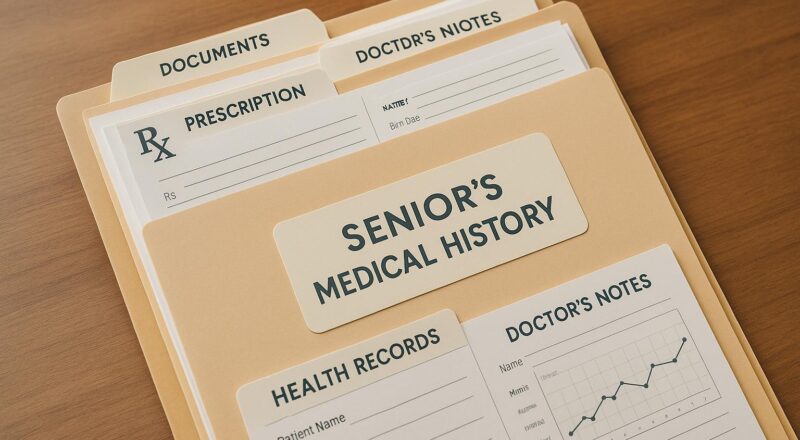
The medical history file is the document that tells the doctor what they need to know in five minutes.
It’s mundane work. It’s also the difference between a hospital admission that goes smoothly and one where information gets reconstructed from memory at midnight, with treatment delays while it gets pieced together. A current, complete medical history file is one of the most consequential pieces of paperwork in a parent’s caregiving life — and it’s almost always missing or out of date.
This post is the practical guide. What goes in the file, how to organize it, who has copies, and how to keep it current as conditions, medications, and providers change.
For the broader documents framework, see Estate Planning Checklist for Adult Children.
What’s in the file.
A complete medical history file has nine sections:
1. Identification and emergency contacts. Your parent’s full name, date of birth, address, phone number. Social Security number (kept secure). Emergency contacts with relationships and phone numbers — at least two. Primary family caregiver listed first.
2. Insurance information. Medicare card details (Original Medicare or Medicare Advantage plan name and ID). Medicaid information if applicable. Supplemental insurance (Medigap or Medicare Supplement) if applicable. Long-term care insurance if applicable. Photocopies of cards, both sides, in the file.
3. Medical conditions. Current diagnosed conditions with rough date of diagnosis. Sample format:
- Type 2 Diabetes (diagnosed 2014, well controlled)
- Hypertension (diagnosed 2008, on medication)
- Mild cognitive impairment (diagnosed 2024, monitoring)
- Osteoarthritis, both knees (chronic)
- Hearing loss, bilateral (using aids since 2020)
Include both active conditions and significant past conditions that affect future care (cancer history, surgeries, organ-specific issues).
4. Medications. Current medications with:
- Name (generic and brand)
- Dose
- Frequency
- Time of day taken
- Prescribing doctor
- Reason / condition treated
- Date started
Plus over-the-counter medications and supplements taken regularly. Vitamins, herbal supplements, melatonin, allergy medications — all count. Many drug interactions involve OTCs.
5. Allergies and reactions. Drug allergies with specific reaction noted (rash, anaphylaxis, GI distress). Food allergies. Latex allergy. Anesthesia complications. Environmental allergies if relevant. Specific reaction matters more than the word “allergy.”
6. Surgical and procedural history. Major surgeries with dates. Significant procedures. Current implants (hip replacements, pacemakers, stents, defibrillators, etc.). Implant details matter for emergency care.
7. Provider list. Primary care physician (PCP), all specialists currently seeing, dentist, ophthalmologist, audiologist. Each with:
- Name
- Practice or hospital affiliation
- Phone number
- Address
- Specialty
- Reason for care
8. Recent medical events. Hospitalizations in the past 5 years. Significant medical events (falls, infections, episodes worth knowing about). Recent diagnostic findings (lab values, imaging results) if specifically relevant.
9. Advance care documents. Copies of:
- Healthcare Power of Attorney (HCPOA)
- Living Will / Advance Directive
- HIPAA release listing authorized recipients of medical information
- POLST or MOLST if applicable
- DNR (Do Not Resuscitate) order if applicable
Originals stored elsewhere; copies in the file for emergency access.
How to organize the file.
A working format that families consistently report works:
Physical binder:
- A 1-inch three-ring binder with labeled tabs for each section.
- Plastic page protectors for documents that need to stay clean.
- A pocket or sleeve for current insurance cards (or photocopies).
- A small section at the front for the most-needed information (medication list, allergy list, emergency contacts).
Digital backup:
- All documents scanned and stored in a password-protected folder accessible to the primary caregiver.
- Updated when paper file is updated.
- Useful for sharing with new providers, distance family, hospital admissions.
Emergency-access summary:
- A one-page summary of the most critical information — name, DOB, allergies, current medications, conditions, emergency contact, primary doctor.
- Magnet-mounted on the refrigerator or in a designated emergency location.
- Hospital staff and emergency responders look for this. Some communities have programs (Vial of Life, File of Life) that provide standardized envelopes.
Who has copies.
Multiple copies, in known locations:
- At the parent’s home (the primary binder).
- With the primary family caregiver (full copy).
- With the HCPOA designate if different from the primary caregiver.
- In the parent’s medical record at the PCP’s office (relevant portions; ask the office to scan and add).
- In the digital backup accessible to authorized family members.
- Travel copy — a small printed summary for trips, especially out of town.
Keeping the file current.
The most common reason medical history files fail is that they’re outdated. Maintenance patterns:
After every medication change: Update the medication list. Same day if possible.
After every doctor visit: Note any new diagnoses, condition changes, recommendations. Update the file accordingly.
After every hospitalization: Update the recent events section. Add new medications. Note any procedures. Refresh as needed.
Annually, regardless: Full review. Verify all listed conditions are still accurate. Verify all listed providers are still being seen. Update insurance information. Review advance care documents for currency.
Set a reminder. Quarterly check-ins, annual comprehensive review. Calendar entry.
When the parent has multiple specialists.
Older adults often have many specialists — cardiologist, neurologist, endocrinologist, ophthalmologist, dentist, etc. The medical history file is even more important when care is fragmented across multiple practices.
Patterns:
- The PCP should be the central coordinator. They need to know what every other provider is doing. Make sure the medical history file is in their record.
- New specialists need the file at first visit. Bring the binder. Don’t rely on the patient’s memory.
- Reconciliation visits. Many PCPs offer comprehensive medication review or care reconciliation visits annually. Use them. Bring the medical history file.
When the parent has cognitive impairment.
For parents with dementia or significant cognitive decline:
- The medical history file becomes more important because the patient can’t reliably report their own history.
- Family member must be present at medical appointments to provide history accurately.
- Specific dementia information should be in the file — diagnosis date, type if known, current stage, recent cognitive testing results, behavioral concerns.
- HIPAA release becomes essential so providers can share information with family members.
What to do during emergencies.
When an emergency happens, the medical history file is what makes hospital intake faster:
- Bring the binder to the ER if at all possible.
- If not possible, the digital copy can be accessed via phone.
- The one-page summary on the refrigerator is what emergency responders look for.
- The HCPOA and advance directive should travel with the binder so they’re available immediately if decisions are needed.
For more on hospital advocacy, see 7 Advocacy Tips for Hospitalized Seniors.
“The medical history file is the document that tells the doctor what they need to know in five minutes. It’s mundane work. It’s also the difference between a hospital admission that goes smoothly and one where information gets reconstructed at midnight.”
FROM THE BINDER THAT SAVED HOURS:
Across years of caregiving, the single most useful document I maintained for my parents was the medical history binder.
It saved hours of reconstruction every time something happened. A hospital admission where the intake nurse could just photocopy the medication list instead of asking the patient (who couldn’t reliably answer). A specialist visit where the new provider got a full picture in five minutes from the binder rather than thirty minutes of fragmented questions. An ambulance ride where the EMTs found the refrigerator summary and knew immediately what conditions and medications were involved.
The thing I underestimated for a long time was how often the binder was used. I’d assumed it was for emergencies. It got used at every appointment, every prescription change, every transition. The investment in keeping it current was modest; the payback was substantial and ongoing.
The other thing I learned: the one-page summary on the refrigerator was the highest-leverage piece. Emergency responders look there. Visiting nurses look there. Aides look there when they have questions. One page, updated when things changed, prevented dozens of small information failures over the years.
If I could send a message back to my earlier self about medical history files, it would be: start the binder before you think you need it. Keep it current with discipline. The time investment is small; the value is enormous.
Honor is in the name of our company for a reason: ElderHonor. Honoring our parents includes the unglamorous work of keeping their medical information organized so that when something happens, the system can respond fast and well. The binder isn’t dramatic. It’s the scaffolding that makes everything else go better.
Where to start today.
If you don’t have a medical history file:
- Buy a 1-inch binder with tabs. $10–$20.
- Spend a Saturday building it. Most of the information is reconstructable from existing records, the parent’s memory, and the doctor’s office.
- Print the one-page summary and put it on the refrigerator.
- Make a digital backup.
- Schedule the first quarterly review.
If you have a file but it’s outdated:
- Pull what’s there. Audit against current reality.
- Update the medication list specifically — this is what dates fastest.
- Verify all listed providers are still current.
- Refresh the advance care documents.
If your parent has been hospitalized recently:
- Update the file with discharge medications, new conditions, recent events.
- Verify what stays from before vs. what’s been replaced.
- Re-share with PCP and other relevant providers.
You’ve got this.
The toolkit’s Documents and Roadmap modules walk through the medical history file template, the maintenance cadence, and the emergency-access framework that turns “we need to look that up” into “here’s the binder” — built so the family can respond fast when something happens.
Some articles that you might find helpful:
- The Estate Planning Checklist — already linked inline.
- The 7 Advocacy Tips for Hospitalized Seniors — already linked inline.
- The How to Create an Emergency Plan — companion piece.
- The Living Wills — for HCPOA and advance directives.
- The Build a Care Plan — broader plan.
- Resource Library — Vial of Life, AAA, Eldercare Locator entries.
Some additional notes:
The “Vial of Life” / “File of Life” programs are real community programs but availability varies by locality.
The HIPAA release framing reflects federal law; specific provider forms vary.
The “PCP as central coordinator” framing reflects best practice but specific care coordination varies by health system.
Back to the Caregiver Library. Read more on Building the plan.