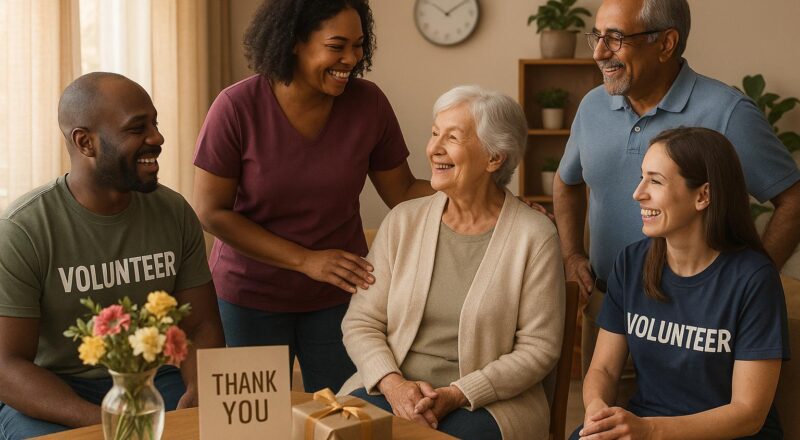
The people who help your parent for free are some of the most undervalued threads in the caregiving setup.
Most caregiving plans focus on the professional support — paid aides, agencies, doctors, paid caregivers. And yet a substantial part of what keeps a parent’s life functioning often comes from people who aren’t paid. The neighbor who walks across the lawn to check in. The friend from church who calls every Tuesday. The cousin who drives in once a month. The grandchildren who FaceTime. The volunteer from the senior center who delivers meals and stays for a chat. These threads get little formal attention and they hold a lot of weight.
This post is about acknowledging, supporting, and sustaining those threads. Not as a courtesy — as caregiving infrastructure that the family can’t actually replace if it disappears.
For the broader support-layer framework, see How to Help Parents Age Safely in Their Own Home.
Who counts as a volunteer in caregiving.
A few categories often present:
Informal community helpers:
- Neighbors — checking in, picking up mail, mowing snow, occasional rides.
- Friends — calling, visiting, providing companionship.
- Religious community members — visiting, bringing meals, offering rides, providing spiritual presence.
- Long-time professional contacts — the hairdresser of 30 years who still comes to the house, the financial advisor who calls because they care, the family doctor who answers the phone after hours.
Extended family:
- Cousins, nieces, nephews, in-laws who help in their own ways.
- Adult children of friends who check on a parent because their own parents asked them to.
- Siblings of the parent who help despite their own age.
Formal volunteers:
- Meals on Wheels volunteers — deliver meals AND check in.
- Hospice volunteers — provide companionship, respite, errands.
- Senior center volunteers — drive, lead activities, maintain programs.
- Religious community visiting programs — often coordinated through a parish, congregation, or community of faith.
The line between formal and informal is fuzzy. What matters is that people are providing real value without being on a paycheck for it.
Why this matters more than families realize.
Three reasons informal volunteers matter:
1. They fill gaps the professional system can’t fill. Paid aides come on schedule. Doctors are reachable during office hours. Volunteers are available in the in-between moments — when something small needs doing, when companionship matters, when an emergency happens to fall on a weekend.
2. They’re often the most consistent humans in the parent’s life. Aides change. Agencies rotate staff. Doctors retire. The neighbor who’s been across the street for 20 years, the friend who’s been calling weekly for a decade — those relationships have continuity that formal care doesn’t.
3. They produce wellbeing the formal system doesn’t. A paid aide can do tasks. A friend produces connection. A volunteer who comes to chat after delivering a meal produces meaning. The wellbeing impact of these relationships is real and measurable, even when the time investment is modest.
When families take volunteers for granted — and most families do — those threads can fray. A neighbor who feels unappreciated stops showing up. A friend who never gets a thank-you eventually drifts. A volunteer organization whose volunteers feel disrespected loses them, and the program loses with them. The infrastructure isn’t free; it just doesn’t bill.
What “appreciation” actually looks like.
Appreciation isn’t a card on a holiday. It’s an ongoing pattern of noticing, naming, and reciprocating. Specific patterns:
Notice and name. “I want you to know how much it means to my mom that you call her every week. It really matters to her.” — said directly to the person providing the help. Specific. Not generic. Not delayed until a crisis.
Communicate impact. People supporting an aging parent often don’t know the full picture of what their support means. Tell them. “When you came over last week and sat with Dad for an hour, he was talking about it for two days afterward. You’re one of the few people who can still get him to laugh.”
Reciprocate. Not always materially. Sometimes a meal. Sometimes a card. Sometimes attention to the helper’s own life and circumstances. Volunteers and informal helpers are rarely lonely martyrs — most have their own lives, their own concerns, their own things they appreciate having noticed.
Include them in updates. When something major happens in the parent’s life — a hospitalization, a transition, a death — close volunteers and informal helpers should be told. They’ve been part of the parent’s life. They deserve to be part of the news.
Coordinate, don’t overwhelm. A common mistake: 12 family members all separately texting the same neighbor to coordinate care, each in their own thread. Pick a primary contact. Coordinate through them. The volunteer’s time is valuable; respect it.
Acknowledge limits. Volunteers can do some things, not others. Don’t ask the neighbor to handle medical decisions. Don’t ask the friend to be the financial backstop. Don’t ask the religious community member to take on full caregiving. Match the role to the relationship.
Specific patterns for specific helpers.
Neighbors:
- Notice the small kindnesses out loud
- Bring back small reciprocities — baked goods, garden produce, quick favors when the family can do them
- Communicate before you’d expect to need to — not in crisis, but in normal time
- Don’t presume on their willingness; ask, don’t assume
Friends and longtime relationships:
- Maintain the relationship for its own sake, not just for caregiving instrumentality
- Update on the parent’s situation as appropriate
- Express gratitude often
- Recognize that the friend may also be aging and may have their own caregiving demands; don’t let the relationship become one-way
Religious community members:
- Engage with the religious community as a whole, not just specific members
- Recognize what the community provides — visits, meals, prayers, spiritual presence
- Reciprocate where possible by participating in the community’s life
- Acknowledge clergy and lay leaders who have provided meaningful care
Formal volunteers (Meals on Wheels, hospice, senior center):
- Acknowledge them through the program — write to the organization
- Give specific feedback to their coordinator about what their work has meant
- Tip thoughtfully where appropriate (some programs prohibit cash; gift cards or written notes are usually welcomed)
- Recognize that their own work depends on volunteers staying engaged — your appreciation helps the program
What to do when a volunteer relationship is failing.
Sometimes informal help patterns don’t work:
- The neighbor who started checking in but is now overwhelmed and resentful.
- The friend who can’t sustain the level of engagement they initially offered.
- The volunteer organization whose specific volunteer is no longer a good fit.
- The family-of-friends helper whose own situation has changed.
Patterns:
- Have the conversation. “You’ve been so generous with your time. I want to make sure I’m not overburdening you. How are you doing?”
- Adjust the ask. Reduce frequency, redefine the role, offer a graceful exit.
- Don’t take it personally if someone needs to step back. People’s lives change.
- Replace the gap thoughtfully. What had been provided informally may need to shift to formal paid support.
When to add formal volunteer programs to the support network.
Many communities have volunteer programs the family hasn’t tapped into:
- Meals on Wheels — the volunteer often becomes a meaningful daily contact
- Hospice volunteers — companionship, respite, errands, even pet visits
- Religious community visiting — many congregations have organized visit programs
- Senior centers — volunteer-led activities, transportation, social engagement
- Friendly visitor programs — through Area Agency on Aging or other senior services
- Pet therapy programs — visits from therapy animals
- Intergenerational programs — students or young people visiting older adults
The Area Agency on Aging (AAA) is the entry point for most. Many programs are free or low-cost. Find your local AAA via Eldercare Locator.
“The people who help your parent for free are some of the most undervalued threads in the caregiving setup. The infrastructure isn’t free; it just doesn’t bill.”
FROM THE HELPERS WE COULDN’T HAVE DONE WITHOUT:
Across years of caregiving, the helpers who held the most weight were rarely the ones I expected.
A neighbor who’d been across the street for decades was a constant low-key presence — checking in casually, picking up mail when needed, occasionally sitting on the porch for a conversation. None of it was big. All of it was meaningful. The neighbor wasn’t a caregiver in any formal sense. The neighbor was someone who genuinely cared about my parent and showed it through small consistent acts.
Friends from earlier life who kept calling, even as conversations got shorter and more limited, kept connection alive when most of the parent’s daily contacts were professional or family. Those calls were holding something the rest of us couldn’t replicate. The shared history, the affection, the long arc of relationship — none of that was reproducible by any aide or family member.
Volunteers from formal programs surprised me with how much value they added. A Meals on Wheels volunteer who’d been delivering for years became someone my parent looked forward to seeing. Hospice volunteers, in the late stretch, provided respite that let the family caregivers rest. Both came at no cost. Neither was something we could have replaced if it disappeared.
What I learned: acknowledge the helpers explicitly, often, and specifically. Generic thanks doesn’t land. “What you do matters because…” — followed by something specific — produces relationship that sustains the help over years. The family that takes the helpers for granted often loses them; the family that names what they’re providing often keeps them through long stretches.
The other thing I learned: the helpers need their own care. Many were aging themselves. Many had their own lives that were evolving. Asking how they were doing — checking on their situation — was part of sustaining the relationship. The relationships that worked were two-way, even when the practical help flowed mostly one direction.
Honor is in the name of our company for a reason: ElderHonor. Honoring our parents includes honoring the people who help us care for them. The infrastructure of informal helpers — neighbors, friends, religious community, volunteers — is part of what makes long-term family caregiving possible. It deserves the same care and intentionality as the formal support layers. Notice them. Name what they do. Sustain the relationships. They’re some of the most undervalued and most important parts of the network keeping your parent in their life.
Where to start today.
If you have informal helpers in your parent’s caregiving network:
- List them. Who’s actually helping, formally or informally?
- For each, identify a specific thing they’ve done recently that’s been meaningful.
- Express that specific gratitude in the next week. Phone call, card, note.
- Communicate ongoing. Make appreciation a pattern, not a one-time thing.
If you haven’t tapped formal volunteer programs:
- Call the Area Agency on Aging for local options.
- Check Meals on Wheels availability.
- Engage hospice volunteer services if hospice is involved.
- Connect with the parent’s religious community if applicable.
If a helper relationship is fraying:
- Have the conversation honestly.
- Adjust the ask.
- Plan replacement for what may need to shift.
You’ve got this.
The toolkit’s Roadmap and Caring for Yourself modules walk through the support-network mapping framework, the appreciation patterns that sustain volunteer relationships, and the formal-program connections that extend the family’s capacity — built so the people who help can keep helping.
Some additional articles that might help:
- The How to Help Parents Age Safely in Their Own Home — already linked inline; support-layer framework
- The Family Caregivers and Hospice Teams — for hospice volunteer context
- The How Home-Delivered Meals Aid Post-Hospital Recovery — for Meals on Wheels context
- The How to Find Local Nutrition Assistance — for community programs
- The 5 Steps to Create a Backup Plan — for backup informal helpers
- Resource Library — Meals on Wheels, AAA, NHPCO entries
Some additional notes:
The “tipping” framing for formal volunteers reflects general practice; specific programs may have policies. Verify before giving cash tips.
Back to the Caregiver Library. Read more on Building the plan.