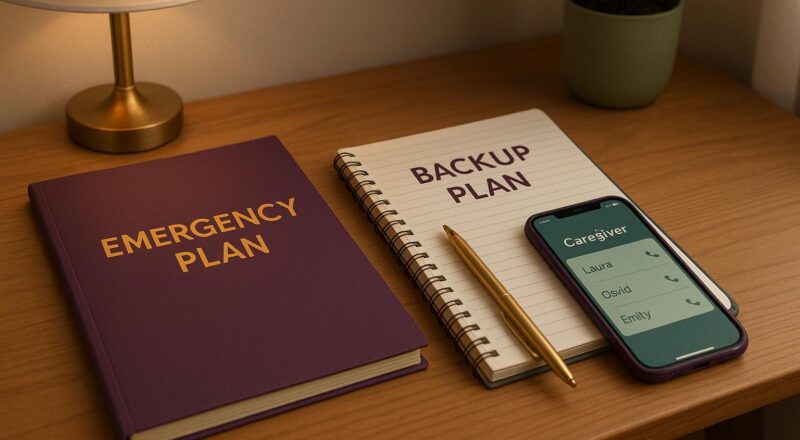
The emergency you plan for is rarely the emergency you get.
Most adult children, when they think about emergencies for an aging parent, think hurricane or tornado. Those happen. The emergencies that show up most often, though, are smaller and more personal. A fall. A power outage during a heatwave. A medication mix-up that produces a hospital trip. A confused neighbor calling at 2 AM because Mom is in their yard. An aide who didn’t show up. Each of these is “an emergency” in the sense that it requires a fast response, and the family that has a plan handles them better than the family that doesn’t.
This post is the practical version of that planning. What kinds of emergencies older adults aging in place actually face, what to prepare for each, and how to build the documents and communication plans that make response faster when something happens.
For the broader aging-in-place framework, see How to Help Parents Age Safely in Their Own Home.
The categories of emergency.
Five categories worth planning for explicitly:
1. Medical emergencies. Falls, heart attacks, strokes, breathing difficulties, sudden cognitive change, allergic reactions. The most common emergency category for older adults.
2. Power and utility outages. Heat or cold extremes, lost refrigeration of medications, lost ability to charge medical devices, lost cooking ability, lost connectivity for medical alert systems.
3. Natural disasters. Hurricanes, tornadoes, wildfires, floods, earthquakes — depending on geography. Often involves mandatory evacuation.
4. Caregiving disruptions. The aide doesn’t show up. The family caregiver gets sick. The transportation arrangement falls through. Common, high-impact, often forgotten in emergency planning.
5. Cognitive emergencies. Wandering, confusion-related incidents, getting lost, refusing care that’s needed. Particularly for parents with dementia.
Each category needs its own planning. Not all need extensive preparation, but none should be unaddressed.
Building the medical emergency response plan.
When something goes medically wrong, fast, coordinated response saves outcomes. The plan that makes fast response possible:
Documents readily accessible:
- Medication list with dosages, frequencies, and prescribing doctors. Updated regularly.
- Allergy list — drugs, food, latex, anesthesia complications.
- Existing conditions with rough timelines and current management.
- Primary care physician’s name and phone number.
- Specialists’ names and contact information.
- Health insurance information — Medicare card, Medicaid card, supplemental insurance.
- Healthcare Power of Attorney (HCPOA) document — physical copy and digital copy.
- Living Will / Advance Directive — physical and digital.
- HIPAA release specifying who can receive information.
- Hospital preference if there’s one in particular the parent prefers.
Keep one set of copies in the parent’s home in a known location (a binder, often labeled “Medical Emergency Information”). Keep another set with the primary family caregiver. Many families also use digital copies — phone photos work in a pinch, secure cloud storage is better. See Estate Planning Checklist for Adult Children for the broader document framework.
Emergency response chain:
- First responder protocol. Who in the family is called first? What’s the backup?
- Notification cascade. Who else gets called when, in what order?
- Hospital plan. Who meets the parent at the hospital? Who stays?
- Decision authority. Who has HCPOA, and is that person reachable? What if they’re not?
Medical alert device. A medical alert system with fall detection — wearable pendant, watch, or in-home unit — is one of the most impactful single investments. One button, immediate response. Many include GPS for parents who travel or wander.
Visible emergency information at home. A magnet on the refrigerator with key contacts, medical conditions, and allergies. Emergency responders look here. Some communities have programs (Vial of Life, File of Life) that provide standardized envelopes for refrigerator-mounted emergency information.
Power and utility outage planning.
A multi-day power outage can be life-threatening for older adults. Plan for it:
Heat and cold extremes:
- Identify a destination — a family member’s home, a hotel, a community cooling/warming center.
- Plan transportation — who picks up your parent if they need to leave?
- Threshold for action. “If the power is out for more than 4 hours and the temperature is forecast above 90°F or below 40°F, we move.” Better to over-respond than under-respond.
Medication storage:
- Identify which medications need refrigeration. Have a cooler available. Know the timeframe before they spoil.
- Pharmacy backup. If insulin or another refrigerated medication is critical, the pharmacy may have backup options.
Medical devices:
- Battery backup or generator for oxygen concentrators, CPAP machines, or other critical devices.
- Hospital alternative. If the device is essential and outages are common, the parent may need to be moved to a setting with reliable power during outages.
Communication:
- Charged phone with backup battery. A small portable battery charger is inexpensive insurance.
- Landline backup if the home has one — works during cell outages in some configurations.
- Family check-in cadence. If a known outage is happening, daily (or more frequent) check-ins.
Natural disaster planning.
Geography determines what to plan for. Common patterns:
Pre-disaster preparation:
- Evacuation plan with destination, route, and transportation arranged.
- Go-bag with medications (3+ day supply), copies of essential documents, change of clothes, comfort items.
- Important documents stored in waterproof container or digitally accessible.
- Pet plan if your parent has pets.
- Communication plan with all family members about how to reach each other if normal channels fail.
Special considerations for aging parents:
- Mobility limitations that affect evacuation logistics. Some parents can’t easily fit in shelters; alternative arrangements may be needed.
- Cognitive limitations that make rapid change especially disorienting. Familiar items and routines matter more during evacuation.
- Medical equipment dependence — oxygen, CPAP, dialysis. These dictate what kind of shelter is appropriate.
- Local “special needs registry.” Many counties maintain a registry of residents with medical or mobility needs, used to prioritize evacuation assistance and welfare checks during disasters. Worth registering.
Caregiving disruption planning.
The aide who was supposed to come this morning is sick. Or the family caregiver who handles weekends has the flu. Or the transportation service canceled. These happen often. Plans for them are often missing.
Backup caregiver tier:
- Primary caregiver (family member or paid)
- Backup caregiver(s) — different family members, agencies, neighbors who can help in a pinch
- Agency backup — if using a paid agency, what’s the backup protocol when the assigned aide is unavailable?
- Worst-case backup — short-term respite care, adult day services, hotel for a parent who needs supervision
Communication chain. Who calls whom when something falls through? What’s the cutoff time before the family activates a backup plan?
Financial buffer for emergencies. Some flexibility in the family’s caregiving budget for last-minute paid help when free help isn’t available.
For the deeper version, see 5 Steps to Create a Backup Plan for Home Care Emergencies.
Cognitive emergency planning.
For parents with dementia, specific planning matters:
Wandering. A significant percentage of people with dementia will wander. Specific preparations:
- Identification. A medical alert bracelet or wallet card with their name, condition, and emergency contact.
- Safe Return-style program. The Alzheimer’s Association’s MedicAlert Wandering Support program enrolls members and helps with return when wandering occurs.
- GPS tracking. A wearable device with GPS, or one integrated into a phone or watch they keep with them.
- Door alarms or smart locks to alert family or caregivers when the parent is leaving.
- Recent photo updated yearly or so, accessible quickly to share with police if needed.
Acute confusion. Sudden cognitive change can signal a medical emergency (UTI, medication issue, stroke, hospital delirium). A plan for what to do when confusion seems sudden:
- Call PCP or go to ER depending on severity.
- Bring documentation — medication list, condition list, baseline cognitive description.
- Watch for treatable causes — infections, medication interactions, dehydration. See How to Assess Cognitive Decline in Aging Parents and 7 Advocacy Tips for Hospitalized Seniors.
The emergency plan document.
A single physical document — a binder, a folder, even a few clearly-labeled pages — that lives in a known location at the parent’s home. Contents:
- Parent’s full name, date of birth, address, phone numbers.
- All family contacts with phone numbers, email, addresses, relationship, role.
- Medical contacts — PCP, specialists, pharmacy, dentist.
- Insurance information — Medicare, Medicaid, supplemental.
- Medication list — current, with dosages.
- Allergy list.
- Existing medical conditions with brief notes.
- HCPOA, Living Will, HIPAA Release (copies; originals stored separately).
- Emergency response protocol — who calls whom in what order.
- Evacuation destinations with addresses and contact info.
- Backup caregiver list.
- Local resources — AAA, transportation services, hospital preference, nearest pharmacy.
- Pet care plan if applicable.
Update quarterly. The most common reason emergency plans fail is that the information is outdated.
Communication plan with the family.
Beyond the document, the family needs an active communication plan:
Group communication channel. A family text thread, group chat, or shared app where notifications and decisions happen. All adult children, plus spouse if present, plus close family who provide support.
Roles defined. Who’s the primary medical contact? Who handles communications with extended family? Who’s the financial decision-maker for emergency expenses? Roles defined in advance work better than roles improvised in the moment.
Cadence of normal updates. A weekly or bi-weekly update from the primary caregiver to the family — what’s been happening, what’s coming up, any concerns. Keeps everyone informed enough that emergency communication is incremental, not panic-from-zero.
Out-of-area contact. A family member or friend who lives somewhere else who can serve as a communication hub if local family is incapacitated by the same emergency. Useful for natural disasters especially.
“The emergency you plan for is rarely the emergency you get. The family that has a plan handles them better than the family that doesn’t — even when the actual emergency wasn’t the one they specifically prepared for.”
FROM A NIGHT THE PLAN MATTERED:
The most useful emergency plan I’ve ever helped put in place wasn’t deployed for the emergency I expected.
Across fifteen years of caregiving for parents and stepparents, I never had a hurricane evacuation, never had a wildfire, never had the dramatic kind of emergency that disaster planning often emphasizes. What I did have were dozens of smaller emergencies — falls in the middle of the night, hospital admissions for things that started as routine, a bad reaction to a new medication, a call from my dad asking me to take him to the hospital— RIGHT NOW!. Every one of those moments worked out better because the basic information was easy to find, the family knew who to call, and the documents were in order.
The single most useful thing across all of those moments was something simple: a one-page summary of medications, conditions, allergies, and emergency contacts kept on the refrigerator or room door. Hospital staff looked there. Aides referred to it. Family members visiting from out of town used it. One page. Updated when things changed. Saved hours of reconstruction every time something happened.
The most useful thing across the family side was the communication chain. Everyone in the family knew who got called first, what the next steps were, and how to reach each other quickly. When something happened at 11 PM, the response was already partly designed. People knew their roles. Decisions got made faster.
What I’d tell families starting on this: the dramatic emergencies are real, and worth planning for if your geography demands it. But the small emergencies are more common, and they’re the ones the plan most often serves. Don’t optimize the plan for the hurricane. Optimize it for the 2 AM hospital call. The plan that works for the 2 AM call usually works for the hurricane too.
Honor is in the name of our company for a reason: ElderHonor. Honoring our parents includes preparing for the moments when honoring them means responding fast and effectively. The plan isn’t paranoid preparation. It’s the scaffolding that lets the family act like a team when something happens — instead of scrambling alone.
Where to start today.
If you don’t have an emergency plan in place:
- Build the one-page summary of medications, conditions, allergies, contacts. Put it on the refrigerator.
- Build the binder with documents (HCPOA, advance directive, insurance) in one location.
- Define the family communication chain — who calls whom, in what order.
- Set up a medical alert device if not already in place.
- Quarterly review scheduled going forward.
If you have a basic plan but it’s been a while:
- Update the medication list and condition list.
- Refresh document copies — HCPOA, advance directive — if anything has changed.
- Check medical alert device function.
- Review with siblings to make sure everyone has current information.
If your parent is in a high-risk situation (recent fall, advanced dementia, frequent hospitalizations):
- Consider 24-hour monitoring options — wearable, in-home, GPS-enabled.
- Increase the frequency of family communication — daily check-ins.
- Have backup caregiver options identified and pre-vetted.
- Consider whether home alone is still appropriate — see Home Care vs. Assisted Living.
You’ve got this.
The toolkit’s Documents and Roadmap modules walk through the emergency-plan binder, the family-communication framework, and the contingency planning that makes 2 AM phone calls survivable — built so the family can respond as a team instead of scrambling.
Some additional links that might be helpful:
- How to Help Parents Age Safely in Their Own Home () — already linked inline; foundational read
- 5 Steps to Create a Backup Plan () — already linked inline; companion piece on caregiving disruptions
- Estate Planning Checklist () — already linked inline
- 7 Advocacy Tips for Hospitalized Seniors () — already linked inline; for hospital response
- How to Assess Cognitive Decline () — already linked inline; for cognitive emergencies
- Home Care vs. Assisted Living () — already linked inline
- Resource Library () — Eldercare Locator, AAA, Alzheimer’s Association MedicAlert entries
Some additional notes:
The “wandering percentage” framing is supported in dementia research but specific numbers vary.
The “Vial of Life” / “File of Life” programs are real community programs but availability varies by locality.
The MedicAlert Wandering Support program (formerly “Safe Return”) is administered by the Alzheimer’s Association; verify current name and program details before publishing.
The “special needs registry” reference exists in many counties but not all; framing as “many counties” is appropriate.
The medical alert device references are not endorsements; products and capabilities evolve.
Back to the Caregiver Library. Read more on Where they’ll live.